Sarajevo Students Visit State Court with BIRN BiH

Students studying at the Faculty of Political Sciences in Sarajevo attended a war-crime trial at the state court with journalists from the Balkan Investigative Reporting Network Bosnia and Herzegovina (BIRN BiH).

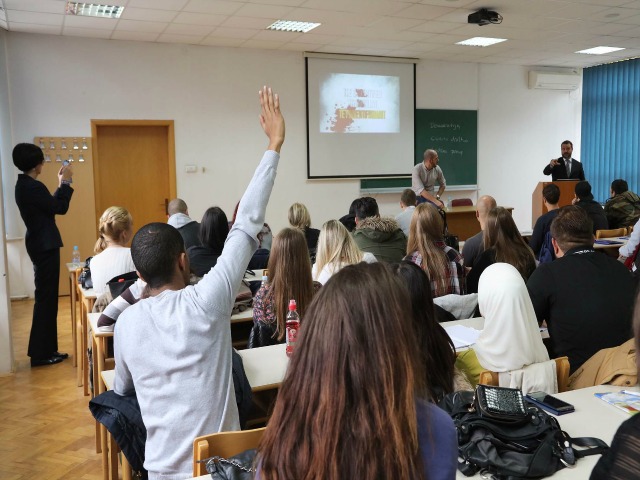
First- and second-year students at the Sociology Department and Security and Peace Studies Department of the Faculty of Political Sciences on Tuesday attended the trial of Djordje Ristanic, who has been charged with committing crimes against humanity in the municipality of Brcko during wartime.

For most of them, this was their first visit to a judicial institution.

The students were led by Emir Vajzovic, a professor and representative of the Institute for Social Research at the Faculty of Political Sciences in Sarajevo.

Erna Mackic, BIRN BiH’s editor-in-chief, addressed the students and explained to them the history of the Bosnian state court’s work in trying war crimes.

The students spoke to Vajzovic and Mackic about the importance of trying war crimes irrespective of the ethnicity of the defendants, as well as the importance of informing the public about the work of one of the highest-level judicial institutions in Bosnia and Herzegovina.  

The students agreed that trying all crimes and coming to terms with the past was necessary for implementing the reconciliation process and sustaining peace in this area.   

The visit to the Bosnian state court resulted from a collaboration between the Faculty of Political Sciences in Sarajevo and BIRN BiH, which involves various joint projects and the education of students in all of the faculty’s departments.  

BIRN Joins Countering Violent Extremism Panel

Balkan Investigative Reporting Network Bosnia and Herzegovina (BIRN BiH) editor Denis Dzidic took part in a panel discussion on methods of countering violent extremism online.

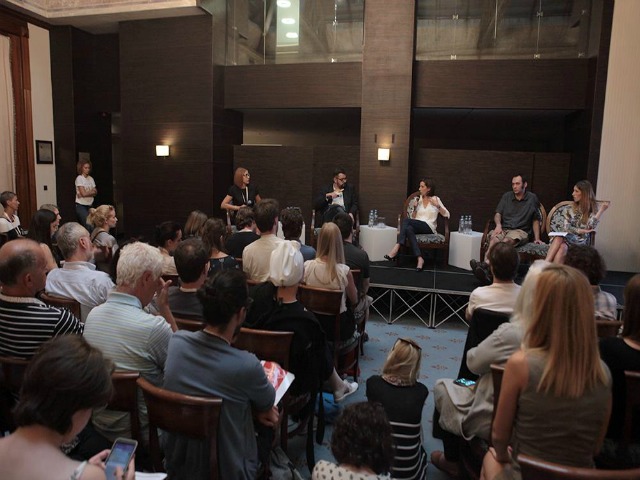
BIRN BiH Denis Dzidic took part in a panel discussion entitled ‘Countering violent extremism online and protection of the right to freedom of speech’ on Friday at the Sarajevo Bristol Hotel, as part of the second annual Bosnian Forum on Internet Management. 

The panelists discussed terrorist propaganda and threat of social media being used to radicalise young people. 

Dzidic said that it is vital for media, when reporting on violent extremism, to be wary of sensationalism, but also added that state institutions should be more open towards journalists. 

“What we are seeing in Bosnia today is that the system is confusing and the way they communicate with journalists is also confusing, so whenever an incident happens, you have on one side institutions that do not want to give any information and even when they do, often different levels give different statements, which leads to sensational headlines,” he said. 

Mario Janacek from the Security Ministry said that Bosnia and Herzegovina was looking for a systematic solution for preventing abuse of the internet for terrorist purposes or any other types of propaganda and hate speech. 

Janacek said that terrorists had moved ahead in terms of using internet platforms, adding that they invested in marketing more than individual corporations. 

“What we currently see in European practices is not promising. It does not look like it might offer any results in terms of removing such material from the internet. It is mainly focused on a certain type of censorship. According to practices applied in most of the countries, such materials are removed without too much thinking about the consequences. In some European countries, police block such content even without court warrants, so we are also considering such possibilities,” Janacek said. 

Analyst and theologian Muhamed Jusic spoke about violent extremism justified by religion, primarily the practice of the so-called Islamic State, as well as giving an analysis of content published and quickly spread on social networks. 

“The internet is not a key factor in radicalisation, which has to go through personal contacts and happen inside smaller circles. There must be someone whom you trust when you speak to them. However, the internet has a great importance in reinforcing those stances and additionally persuading yourself that what someone told you during a closed meeting was true,” Jusic said. 

The participants at the panel discussion also discussed projects aimed at creating positive narratives via the network of ‘Super Citizens’, who are fighting against hate speech, as well as the role of the media in reporting on radicalisation and terrorism.

BIRN’s Kosovo War Film Screened at Sarajevo University

Sarajevo University’s law and political sciences faculties screened BIRN’s documentary ‘The Unidentified’, about the Serbian fighters responsible for some of the worst atrocities of the Kosovo war in 1999.

‘The Unidentified’, which investigates attacks on Kosovo villages in 1999 and names those involved in an attempted cover-up operation to conceal the crimes, was screened for students of communications, security, journalism and law at Sarajevo University on Tuesday and Wednesday.

“My idea was to make sure that, when people hear and watch this film, be it in Belgrade, Novi Sad or Kragujevac, they will not be able to say that no crimes happened in Kosovo,” the film’s director Marija Ristic said in a video message to the students.

‘The Unidentified’ was made as a result of two years of research, and takes viewers back to the villages of Ljubenic, Cuska, Pavljan and Zahac, near Pec/Peja in Kosovo, in the spring of 1999, when Serbian forces killed more than 118 Albanian civilians.

The victims’ bodies were burned or removed, and some of them were subsequently found in a mass grave at a police raining centre in Batajnica, near Belgrade, in 2001. Eleven former members of Serbian forces are on trial in Belgrade for committing those crimes. In February 2014, nine men were sentenced to a total of 106 years in prison, but the appeals court quashed the verdict in March last year, saying it was “incomprehensible and contradictory”, and ordered a retrial.

Midhat Izmirlija, a professor at the Faculty of Law, said after the screening that ‘The Unidentified’ was a great example of socially-engaged journalism.

“This is an excellent way for the media to work with the aim of determining the truth about certain events and presenting the truth to the victims and the public,” Izmirlija said.

Lejla Turcilo, a professor at the Faculty of Political Sciences, said it was very important for young journalists to be exposed to such works of research works during their studies.

“Our students do not come across these type of stories while studying theory. Our goal is to offer them practical experiences, which they lack during their education, but it is important not to always engage in daily journalism, but in investigative journalism, which is scarce,” she added. She said such projects could motivate students by “showing them there is a possibility for making changes in society”.

Following the screening of the documentary, the Law Faculty students had a lecture and held a discussion on the legal challenges involved in monitoring war crime trials, while the students at the Faculty of Political Sciences had a discussion on journalism and transitional justice with BIRN Bosnia and Herzegovina editor Denis Dzidic.

Serbian Culture Ministry Gives Support to Belgrade Insight

The Ministry of Culture and Information of the Republic of Serbia provided support for BIRN’s Belgrade Insight starting in September 2016 as part of the annual assistance it provides for local media outlets through open call for proposals.

The ministry’s support was provided through financial assistance to help cover the costs of coordination, distribution and printing of seven issues of the publication. 

Belgrade Insight, which began circulation in 2008, covers all aspects of life in the Serbian capital – from politics to business, culture to sport and lifestyle to current affairs. It still remains the only biweekly newspapers in English language in the Serbian capital.

BIRN Holds Transitional Justice Training in Sarajevo

BIRN Hub opened a two-day training course on transitional justice reporting for 23 journalists from Bosnia and Herzegovina, Croatia, Montenegro, Macedonia, Kosovo and Serbia.


The two-day training course began in Sarajevo on Thursday with the aim of introducing the 23 reporters to the topic of transitional justice from a journalistic perspective and deepening their knowledge of war crimes trials and related issues.

The training started with a regional conference entitled ‘War Crimes Proceedings and Regional Cooperation’ which gathered prosecutors, experts and journalists from across the former Yugoslavia.

Journalists had the chance to watch a debate which was also addressed by representatives from the OSCE, the EU-rule-of-law mission in Kosovo, EULEX and the International Criminal Tribunal for the Former Yugoslavia.

The prosecutors talked about challenges to war crimes prosecutions in the Balkans, particularly in light of the ICTY closing its doors next year.

The training continued with an afternoon session which hosted Kevin Hughes, legal adviser to the chief prosecutor at the ICTY, who gave an overview of international courts and tribunals as well as the ICTY’s achievements and legacy.

Sven Milekic, a journalist from Croatia who works on BIRN’s Balkan Transitional Justice project, outlined the concept of transitional justice as well as the role of journalists in war crimes trials.

Denis Dzidic, a journalist from Bosnia and Herzegovina who works on BIRN’s Balkan Transitional Justice project, gave an insight to transitional justice resources for journalists as well as looking at the obstacles facing transitional justice reporters and how to deal with them.  

Dzidic then gave an overview of war crimes trials in Bosnia and Herzegovina together with Ivan Jovanovic, an international humanitarian law expert who gave an overview of war crimes trials in Croatia, Kosovo, Serbia, Montenegro and Macedonia.

As part of the training session, BIRN launched its War Crimes Verdicts Map – an interactive tool intended to provide an overview of court rulings on the crimes that were committed during the wars in the former Yugoslavia in the 1990s.

Comprising a total of 386 verdicts, it represents a unique database of publicly-available final judgements issued by national courts in Bosnia and Herzegovina, Croatia, Montenegro, Kosovo and Serbia.

It also includes verdicts handed down by the International Criminal Tribunal for the Former Yugoslavia in The Hague.

On the second day of the training course, the journalists visited the Court of Bosnia and Herzegovina, where they had a guided tour and attended a war crime case hearing at which the closing arguments were given by the state prosecutor.

After the visit to the court, the group was given a presentation at the International Criminal Tribunal for the Former Yugoslavia’s Liaison Office in Sarajevo by the office representative, Almir Alic.

At the afternoon session, the journalists met with Boris Grubesic, the head of the Public Relations Department at the Prosecutor’s Office of Bosnia and Herzegovina, Murat Tahirovic, president of the Association of Victims and Witnesses of Genocide, and Lejla Softic from the International Commission on Missing Persons.

BIRN Bosnia and Herzegovina journalists Erna Mackic and Marija Tausan then gave a presentation about the challenges and pitfalls of court reporting.

The conference and the training session are part of BIRN’s Balkan Transitional Justice initiative, funded by the European Commission, the Federal Department of Foreign Affairs of Switzerland and the Robert Bosch Stiftung.

The project aims to improve the general public’s understanding of transitional justice issues in former Yugoslav countries – Bosnia and Herzegovina, Croatia, Kosovo, Macedonia, Montenegro and Serbia.

To find out more about the conference: http://www.balkaninsight.com/en/article/birn-to-host-regional-conference-on-war-crimes-prosecution-09-20-2016


BIRN Summer School Day 4: Scaling Up Investigations

On the fourth day of BIRN’s Summer School, trainers advised the journalists on how to pitch stories, structure investigative projects and use technology to assist their work.


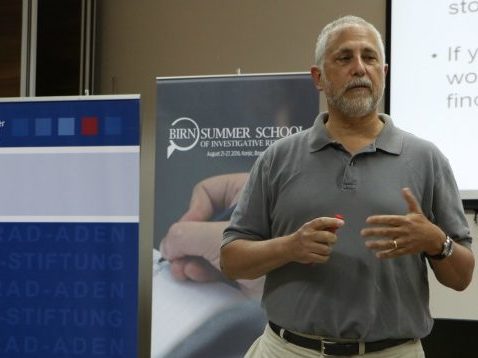
The fourth day of BIRN’s Summer School Master Class of Investigative Journalism in the historic town of Konjic in Bosnia and Herzegovina on Thursday started with a session on pitching story ideas, run by Blake Morrison, lead trainer and investigative projects editor at Reuters.

Blake explained how stories can be pitched to editors without overpromising while bearing in mind all the possible outcomes.

“As reporters, you’ll have real highs and real lows, and we have a job to even them up… Sometimes as investigative reporters we dig a dry well and that’s normal. But nevertheless, we aim to have less of them,” he told the participants.

“Sometimes you work on a story that just doesn’t resonate. And that’s why we have to give them ‘legs’, which will make them have an effect,” he added.

Blake explained that journalist should not promise too much from a story and must be realistic, but nevertheless should believe in the most positive outcome, while not pretending it’s possible to predict every possible outcome of their research.

Blake concluded that journalists should know that they are not alone in their work, and if they do not have editors to support them, they should find support among colleagues or elsewhere.

Lawrence Marzouk, a journalist and editor with Balkan Investigative Reporting Network, BIRN, shed light on a case study about the arms trade from the Balkans and Central Europe to the Middle East, a report that caused serious reactions in the countries mentioned.

“You should first ‘pick the lowest hanging fruit’,” he said, while explaining how the reporting team tracked 1.2 billion euros of weapons sold to Middle Eastern countries.

Marzouk explained how reporters, while researching a “controversial industry” like the arms trade, “have to harvest all the possible open source databases” because the industry is highly regulated, meaning that there is a lot of documentation.

“To find the weakest link in the system, you have to know the system,” he.

Participants then had the opportunity to discuss techniques and databases with Marzouk using the arms trade story as an example.

Miranda Patrucic, an investigative reporter and regional editor with the Organized Crime and Corruption Reporting Project, presented her work connected to the Panama Papers, giving an insight into how the research was done.

Patrucic explained how the offshore industry functions, through proxies, different types of companies, trusts and bearer shareholders. She also explained the interest countries with tax heavens have in allowing offshore companies to operate.

“These island states are very small with small costs. And all the documents for opening offshore companies, such as a certificate of good standing, cost something and the states make a significant profit on it,” she explained.

By showing concrete examples from the Panama Papers, Patrucic explained to the participants how to ‘follow the money’ and the businesses of offshore companies.

The former editor at the Milwaukee Journal Sentinel, Martin Kaiser, ended the day with his masterclass session on investigative journalism.

“First of all, a journalist’s first obligation is to the truth,” Kaiser said.

“[Journalism’s] essence is discipline and verification… it must serve as an independent monitor of power,” he added. “It must provide a forum for public criticism and compromise, meaning you have to listen… We make mistakes and when we do, we correct them.”

He also said that stories must be interesting and relevant.

“You got a significant story, how do you make it interesting? How do you make it relevant? How do you write in such a manner that it captures people’s attention?” Kaiser asked.

He explained that contemporary journalism has to use all the newest technologies and tools for writing stories, but underlined that journalists should remain “great storytellers” who “shed light where there was darkness”.

After presenting an outline of his work on a story about the high incidence of drunken drivers in the US state of Wisconsin, Kaiser gave the participants the opportunity to discuss what works and what does not in investigative journalism.

The Summer School is organised by the Balkan Investigative Reporting Network, BIRN, in cooperation with the Media Program South East Europe of the Konrad-Adenauer-Stiftung and with the support of the Open Society Foundations and USAID Macedonia.

BIRN Summer School Day 3: Interviewing Techniques and Sourcing

On the third day of BIRN’s Summer School, journalists heard how to harness the power of social media, carry out interviews and develop sources for stories.

The third day of BIRN’s Summer School Master Class of Investigative Journalism started with Paul Myers, an expert in using social media for investigations, offering tips on searching Twitter and Facebook for investigative stories

“If you have to approach the person on social media, try to do it over the publication’s [media] account and not your private account, and then people will attack your company and not you,” Myers told participants at the school, held this year in the historic town of Konjic, in Bosnia and Herzegovina.

“In short, everybody we’re investigating is either on Facebook or has family on Facebook. The information you can get from different social networks, websites, directories are offering a mosaic of information that you can wander around […] proving things that need to be proved, finding new information you didn’t have before that will help to develop your stories,” he added.

Blake Morrison, lead trainer and investigative projects editor at Reuters, held a session on the art of interviewing.

Morrison said: “My philosophy on interviewing is pretty simple… Think of it as an important meeting. With a stranger,” explaining that the interviewee needs to “be understood”.

“It’s important to be authentic, because people can tell when someone is unauthentic and misrepresent themselves,” he added.

“If we do a job well, there is nothing to be embarrassed about. That’s the confidence I am talking about,” Morrison said.

“It’s very important to be curious. If you don’t understand something, don’t presume, ask,” he concluded.

He explained that there are three types of interview: information interviews, which involve collecting information on something; accountability interview, asking the person to explain his or her acts; and emotional ones, in which person sheds light on his or her emotional perspective.

Morrison emphasised the need for preparation and gave an insight into why people agree to give an interview: vanity, need to be understood, self-interest, desperation, guilt and curiosity.

Jim Mintz, an adjunct professor of the Stabile Centre for Investigative Journalism at the Columbia Journalism School, spoke about how to develop sources.

“I am here to spur your ambition to go deeper in developing sources,” he emphasised, “and not expose only people that are responsible for wrongdoings, but systems of wrongdoing”.

“All investigative stories start from outside and one wants to get inside. Since things are in the heads of people, one must have skills for developing source,” he added, explaining that journalist must enter a “deep inside a secret world”.

Mintz explained that entering this “secret world” will lead journalists into complicated “mazes” of complex relations and events.

“In this maze, you’ll find people that genuinely can help you, that can guide you,” he said.

Mintz explained that journalists should try to develop genuine relationships with sources.

He concluded that it is very important that journalists work hard in order to gain the trust and respect from sources.

After the joint sessions, participants split into smaller groups for sessions with Mintz, investigative reporter and regional editor with the Organized Crime and Corruption Reporting Project, Miranda Patrucic and former editor at Milwaukee Journal Sentinel, Martin Kaiser.

The Summer School is organised by the Balkan Investigative Reporting Network, BIRN, in cooperation with the Media Program South East Europe of the Konrad-Adenauer-Stiftung and with the support of the Open Society Foundations and USAID Macedonia.
BIRN Summer School Day 2: Social Media for Investigators

On the second day of BIRN’s Summer School, journalists learned how to creatively structure stories and use various databases and other investigative tools.

Lead trainer and investigative projects editor at Reuters, Blake Morrison, showed the participants of the BIRN Summer School Master Class of Investigative Journalism in Konjic, Bosnia and Herzegovina on Tuesday how to use a creative approach to structuring stories.

Morrison emphasised the need to persuade people who are sceptical about the narrative.

“Your job is to persuade people who fundamentally disagree with what you say,” Morrison said, underlining the importance of being imaginative when structuring a story.

“I want you to imagine the best story possible. To ask yourselves: ‘What would be the best source [for the story] imaginable that’s out there,’” he said.

“You need to believe that you’re able to make any story possible… but you need to manage your stories possible,” Morrison told the participants.

He explained how all investigative stories should be explained within six words and can be described using three questions: what is the issue, what is the harm and who is to blame.

Morrison concluded that journalists have to ask themselves the “so what?” question – why is something important – and “why now?” question, which explains the importance of the story at that moment in time.

Also on Tuesday, Crina Boros, a watchdog reporter from Centre for Investigative Journalism, continued her training on data journalism, answering questions from the participants through stories she has covered over the years.

She showed the participants how to use public registers and databases while writing stories.

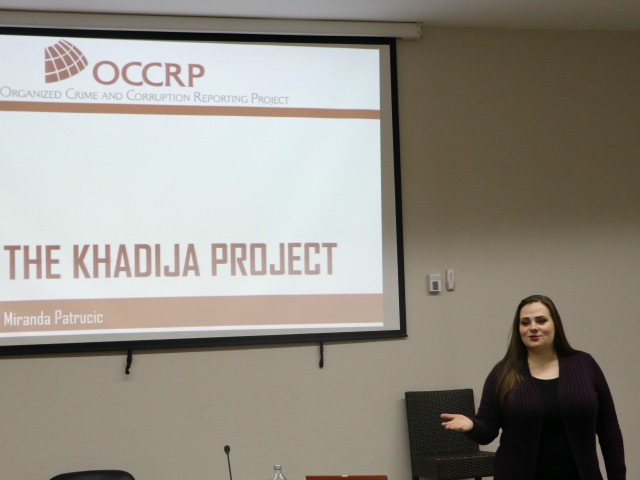
Miranda Patrucic, an investigative reporter and regional editor with the Organized Crime and Corruption Reporting Project, also held an interactive lecture on how to ‘follow the money’ and find sources for stories abroad.

She presented The Khadija Project – named after Azerbaijani investigative journalist Khadija Ismayilova, who was imprisoned in Azerbaijan after reporting on the financial schemes of President Ilham Aliyev’s family. 

“One day she [Ismayilova] took part in a training, like the one you will get today, and learned how to follow the money abroad,” Patrucic told the participants.

She did an exercise about tracking money and companies through various databases, both open-source and paid-for.

Paul Myers, an expert in using social media for investigations, did a presentation on technical sites, tools and techniques. He showed how keywords are searched on Google and through social media, cutting the number of search results.

“Logic dictates search on Google, so you have to think what you search and discover logic behind it and look for that in Google,” he explained, while showing practical examples.

The Summer School is organised by the Balkan Investigative Reporting Network, BIRN, in cooperation with the Media Program South East Europe of the Konrad-Adenauer-Stiftung and with the support of the Open Society Foundations and USAID Macedonia.

The seventh BIRN Summer School has brought together young journalists from Albania, Austria, Bosnia and Herzegovina, Bulgaria, Croatia, Greece, Hungary, Ireland, Kosovo, Macedonia, Montenegro, Romania, Serbia, Slovenia, United Kingdom and the United States of America.


Seventh BIRN Summer School Begins in Bosnia

BIRN’s latest Summer School kicked off on Monday with interactive sessions on data journalism and fact-checking.

Journalists from across Europe and the USA have gathered in historic town of Konjic in Bosnia and Herzegovina for the BIRN Summer School Mater Class of Investigative Journalism.

After greeting this year’s participants, Blake Morrison, the school’s lead trainer and investigative projects editor at Reuters, held an interactive exercise on establishing facts in stories. Morrison showed journalists how to hone in on important details in complex investigations.

The first day continued with an introductory workshop on data journalism with Crina Boros, a watchdog reporter from Centre for Investigative Journalism, during which participants learnt the analytical tools needed for data journalism.

In the afternoon, the participants divided up into smaller group for in-depth sessions with Morrison and Martin Kaiser, a retired editor who led the Milwaukee Journal Sentinel to three Pulitzer prizes.

The Summer School is organised by the Balkan Investigative Reporting Network, BIRN, in cooperation with the Media Program South East Europe of the Konrad-Adenauer-Stiftung and with support of the Open Society Foundations and USAID Macedonia.

The seventh BIRN Summer School brings together young journalists from Albania, Austria, Bosnia and Herzegovina, Bulgaria, Croatia, Greece, Hungary, Ireland, Kosovo, Macedonia, Montenegro, Romania, Serbia, Slovenia, United Kingdom and United States of America.

BIRN Presents War Stories at Sarajevo Film Festival

The first ‘True Stories Market’ aimed at film and TV professionals at the Sarajevo Film Festival included three stories from BIRN relating to Bosnia and Herzegovina’s wartime past.

The first ‘True Stories Market’ was held at the 22nd Sarajevo Film Festival on Wednesday as part of the Dealing with the Past project, after a screening of ‘Depth Two’ by Ognjen Glavonic from Serbia.

The market is intended to serve as an inspiration to directors, producers, film and television professionals to turn genuine and rarely-told stories into feature and documentary films.
 
At the first market, the Balkan Investigative Reporting Network Bosnia and Herzegovina (BIRN BiH) presented three stories, created out of BIRN journalists’ long-term work on dealing with the past, documenting war crime trials and collecting the testimonies of survivors.
 
BIRN BiH director Mirna Buljugic familiarised the directors and producers with a story about the village of Baljvine, where no conflicts between Bosniaks and Serbs have ever happened, about the phenomenon of how numerous victims of sexual abuse cannot get pregnant, and about one man’s daily search for bones of the victims of the Srebrenica genocide.
 
A total of seven stories about the recent past and unhealed wounds were presented at the market that the Sarajevo Film Festival organised in collaboration with institutions from Bosnia and Herzegovina, Croatia, Montenegro, Serbia and Kosovo.  
 
The Dealing with the Past project was launched last year under the auspices of the Robert Bosch Stiftung with the aim of using the film industry to intensify dialogue in the region and promote peace through raising awareness and spotlighting indisputable facts about the 1990s conflict.

The project encourages the participation of the public, primarily the younger generation, to foster understanding, acceptance and the tolerance of mutual differences.  

The Dealing with the Past project continued on Thursday with screenings of the films ‘The People vs. Fritz Bauer’ by Lars Kraume and ‘Unwanted Heritage’ by Irena Skoric. The screenings are being followed by debates.