BIRN Investigation Wins EU Award for Best Investigative Journalism in Bosnia

Jury members praise probe into massive online pyramid scheme as ‘textbook example of good journalism, saying it ‘reads like a crime novel’.

Detektor journalists Nino Bilajac and freelance Selma Ucanbarlic won First Prize in the European Union’s Award for Investigative Journalism for their work on the pyramid scheme of eMagnetix that cost many people their investments.

Bilajac and Ucanbarlic shared the prize with Aljazeera Balkans journalist Arduana Pribinja, who was awarded for the story, “Female Patients’ Accusations of Sexual Harassment in Zenica Hospital”.

During the investigation, “Dream Jobs Become Nightmares for Bosnians Lured By Hungarian’s Online Pyramid Scam”, which was carried out in cooperation with Raskrinkavanje, Detektor infiltrated the scheme and discovered that its organiser had registered fictitious companies in European countries, one of which is already under investigation for fraud.

The jury composed of Nidzara Ahmetasevic, Ozren Kebo and Dragana Dardic called Detektor’s investigative piece “a rarely well-researched story with numerous international and domestic sources – a textbook example of good journalism”.

“The effort invested in organising and explaining all the facts is obvious, and that effort deserves a reward. The combination of several journalistic genres with an innovative approach makes this article read like a crime novel,” Dardic said at the award ceremony in Sarajevo.

She added that everything was supported by statements, field trips, interviews with lawyers, expert findings, and that the story went beyond the borders of Bosnia, following the suspicious operations of the Hungarian tycoon’s company and revealing how he had deceived hundreds of people.

“We hope that this award will make the story more visible not only to the public but also to journalists in the region, and that we will read more stories done in this way,” Dardic said.

Bilajac said almost the entire organization had worked on realizing the investigation, with he and Ucanbarlic as the final authors, because the investigation’s international character required a lot of time, resources and patience.

“Pyramid schemes are hard to stop but I hope that, following this, research, investigative and security agencies will have a little more motivation to prevent .. this type of fraud – and that all those who think they can make money by doing nothing will finally realize that it is impossible and that … in no way can you earn thousands and thousands by clicking on the Internet,” he said.

Ucanbarlic said the story explained how one of the most massive pyramid schemes in the region had developed.

“This is not just a story about this pyramidal scam; this story warns of the dangers of cybercrime that threaten our communities and citizens every day, and therefore it is really important that we continuously report on this topic and warn our citizens, so that they do not become victims of cybercrime,” she added.

Second Prize was awarded to Dejan Rakita, from Misli o Prirodi portal and Detektor correspondent, for the story, “Trgovska gora: Why and how it was chosen, what exactly is being built there and what dangers it brings us”.

Third Prize was shared between Zurnal journalists Zinaida Djelilovic and Azra Omerovic for the story “International University of Gorazde: Doctor of Dentistry Obtained Degree Even though Faculty Had No Students Enrolled”, and Azhar Kalamujic, a journalist from the Center for Investigative Journalism (CIN), for the research, “Call Beg for Parking”.

EU Ambassador to Bosnia Luigi Soreca said during the award ceremony that journalism without fear and intimidation was the cornerstone of democracy.

“Today I want to honour the courage and dedication of investigative journalists across BiH, especially since journalists are too often the targets of threats,” he said, adding that the EU would continue to insist on the institutional protection of journalists.

Bilajac joined Detektor in 2022 and has received numerous awards, including the Eco Journalist Award for 2022, the EU Award for Investigative Journalism in 2021, as well as the Award for Outstanding Merit in Investigative Journalism in 2018 given by the South East European Media Organization (SEEMO) and the Central European Initiative (CEI).

He was shortlisted in 2017 for the Young Journalist Award given by the Thompson Foundation, and the European Press Prize in 2021.

The EU Award for Investigative Journalism celebrates the best investigative stories produced in the previous calendar year.

It is awarded in all six Western Balkan countries – Serbia, Bosnia and Herzegovina, Albania, Montenegro, Kosovo, North Macedonia, and Turkey.

Call for Applications Open: Reporting Digital Rights and Freedoms – Fellowship 2024 – Second Round

The Balkan Investigative Reporting Network (BIRN) is announcing the second open call for the Digital Rights and Freedoms Journalist Fellowship 2024. This initiative is designed to support and mentor journalists and media outlets in producing investigative stories that highlight and address the critical challenges of digital rights violations.

Empowering Journalism in the Digital Age

Awarded journalists will have a unique opportunity to collaborate closely with BIRN editors and our specialized digital rights team. As part of the fellowship, you will gain access to BIRN’s comprehensive monitoring database along with other valuable resources to support your investigative work. This collaboration is designed to equip you with the tools and knowledge necessary to delve deep into digital rights issues and produce impactful journalism. Ultimately, your written content, upon editors’ approval,  will be showcased as a long-form investigative piece in one of the BIRN’s channels (including but not limited to Balkan Insight, BIRD, local BIRN websites), offering a platform for amplifying your work with the aim to  inform and engage a wide audience.

What We Offer

  • Grants of EUR 1,000 for individual journalists or collaborative teams, intended to support six months of research focused on in-depth storytelling related to digital rights and freedoms.
  • On-the-job mentoring from BIRN editors and our Digital Rights Support Team, plus a two-day online training session to hone your investigative skills.
  • Networking opportunities with like-minded journalists and tech researchers across the region, building a network of professionals dedicated to safeguarding digital rights.

Who Can Apply?

  • Professional journalists and tech researchers, both individuals and teams, from media outlets from Albania, Bosnia and Herzegovina, Kosovo, Montenegro, North Macedonia, Serbia, Turkey.
  • Previous participants of BIRN’s training are especially encouraged to apply.
  • We welcome cross-border team applications to foster regional collaboration.

Application Process

To apply for the Digital Rights and Freedoms Project Fellowship, please use this ECR form to submit your application. Ensure you include:

  • A detailed proposal outlining your intended story or investigation, focusing on its relevance, originality, and potential impact.
  • Your professional CV, with an emphasis on your past work in journalism or digital rights research.
  • A declaration form, affirming the authenticity of the information provided and your commitment to the project’s ethical standards.

BIRN will also organise an information session on 5 November 2024 at 13:00 (CET), and registration is open. Register HERE.

Submission Deadline: November 11, 2024

Selection Criteria

Applications will be evaluated based on:

  • Relevance and significance of the proposed story
  • Feasibility and originality
  • Applicant’s professional qualifications and experience

A committee established by BIRN’s editorial team and an external professional will review the proposals.

Contact Us

For more information, please contact [email protected].

Join us in our mission to defend digital rights and freedoms. Apply now for the second round of Digital Rights and Freedoms Project Fellowship 2024!

BIRN’s Report on Open Data and Digitalization in Western Balkans Presented in Skopje

On October 18 in Skopje, representatives of state institutions, non-governmental organizations and researchers from North Macedonia discussed the main findings of BIRN’s report, Open Data and Digitalization in the Western Balkans: The State of Play.

The event brought together 15 representatives from state institutions, academia, non-governmental organizations and the media to review the main conclusions.

Open Data and Digitalization in the Western Balkans: The State of Play analyses the availability and digitalization of open data in the Western Balkans, thousands of e-services and maps over 3,000 open data sets.

More than 50 interviews were conducted to explore the capacities and engagement of key stakeholders in these areas. The research also highlights negative trends, such as data leaks, privacy breaches, inadequate responses to cyberattacks and inconsistent policy implementation, which pose challenges to progress.

The event in Skopje, moderated by the national researcher for North Macedonia, German Filkov, highlighted the main conclusions from the report and the research process, while also providing a platform for dialogue on open data and digitalization efforts both within the country and across the region.

The event began with a presentation by Filkov who outlined the research process, key conclusions and takeaways from the report.

This was followed by a panel discussion that included Gordana Dimitrovska Gapic, Open Government Partnership’s National Coordinator, Marijana Janceska from Foundation Metamorphosis and Konstantin Bitrakov, a researcher and teaching assistant at the Faculty of Law at Skopje’s Ss Cyril and Methodius University.

Gapic emphasized the importance of a structured and ongoing involvement of all institutions and stakeholders in the process of opening and utilizing data. She also shared insights into the creation of the national portal, uslugi.gov.mk, highlighting the need for continuous promotion of the platform to ensure its success and wider adoption.

Janceska shared Metamorphosis Foundation’s work on opening data sets and providing mentorship for state institutions and local municipalities.

Konstantin Bitrakov shared his perspective on the need for open data and digitalization, viewed through an academic lens and within the context of the national legal framework.

The final conclusions emphasized the need for the full digitalization of services and the opening of more data sets for citizens in North Macedonia.

It was also noted that a robust system is essential to support these efforts, ensuring the regular maintenance of both the digitalized services and the opened data sets.

The report can be found here.

BIRN Albania Holds Lectures and Rountable on Disinformation

The Balkan Investigative Reporting Network in Albania held three open lectures at Albanian universities and one roundtable on disinformation narratives against NATO and the EU in Albanian media, with more than 110 participants.

The lectures and the rountable presented the findings of the BIRN Albania’s newest study on disinformation narratives against NATO and the EU from hostile states, which was funded by the Open Information Partnership.

The lectures were attended by 88 students, while 30 stakeholders from the fields of journalism, media, research, and civil society participated in the rountable held in Tirana.


As part of the study, BIRN Albania monitored more tha 196,000 news articles from 36 Albanian media outlets over a one-year period (May 2023 to May 2024) to identify anti-NATO and anti-EU narratives.

The lectures were held at the European University of Tirana, Beder University and Luigj Gurakuqi University in Shkodra. The rountble was held on October 18 in Tirana.

During the roundtable, Besar Likmeta, Editor-in-Chief of BIRN Albania, shared the findings on the main narratives against NATO and the EU that were most often repeated in the monitored media.

He emphasized that these narratives include claims that NATO is an expansionist organisation pursuing an agenda to destabilize the Balkans, that the EU is divided and unable to protect its citizens, and that the West supports elites at the expense of the people. Likmeta also presented several common features that help distinguish disinformation articles from credible reporting.

Meanwhile, Viola Keta, a journalist and co-author of the study, discussed some of the challenges in reporting news related to NATO, the EU, and related topics, along with recommendations identified during interviews with media managers, editors, journalists, and social media managers from some news media in Albania.

At the end of the events, participants expressed their concerns about disinformation narratives and discussed possible future steps to counter them.

EU Awards for Best Investigative Journalism in North Macedonia Presented

Five journalists from North Macedonia were handed prizes at the EU Investigative Journalism Awards ceremony on October 18 in Skopje.

Stories on the misusage of medications in Skopje’s oncology hospital, political corruption, misuse of public funds and illegal destruction of forestry were selected as the best investigative stories in North Macedonia for 2023.

Irena Mulachka, Miomir Serafinovikj, Snezhana Lupevska Sozen, Aleksandar Metodijev and Suzana Miceva were announced as winners at the 2024 annual EU Investigative Journalism Awards at Europe House in Skopje.

First prize went to Irena Mulachka from Fokus for her investigation into corruption in Skopje’s oncology hospital, where medications were misused to serve the personal interests of staff and management.

Second prize went to Miomir Serafinovikj and Snezhana Lupevska for their story published on an investigative broadcast TV show exposing political corruption and misuse of public funds through family connections.

Third prize went to Aleksandar Metodijev and Suzana Miceva from Nota.mk for their story, which sheds light on illegal logging in Jablanica mountain, involving cross-border criminal activities.

The jury consisted of Konstantin Testorides, Lajla Veselica and Valentin Nesovski.

Konstantin has over 40 years of experience in journalism starting his career with Tanjug News Agency and joining Associated Press in 1992.

Lajla brings over 25 years of working experience including working with The New York Times on the Balkans and as correspondent for Agency France-Press.

Valentin has 25 years of experience in strategic communications and media working in national and international outlets.

Michalis Rokas, Ambassador of the European Union to North Macedonia, gave a speech at the ceremony reconfirming the European Union’s support for investigative journalism in North Macedonia and internationally. He also handed the awards to the winners.

BIRN Investigation Shortlisted for Daphne Caruana Galizia Prize for Journalism 2024

Story looking at European Commission’s proposal to scan for child sexual abuse material online is one of 13 nominations for this award.

“Who Benefits?’ Inside the EU’s Fight over Scanning for Child Sex Content”, a BIRN investigation, is among 13 stories nominated for the Daphne Caruana Galizia Prize for Journalism 2024. The nomination was announced on October 18.

The investigation, by BIRN’S investigative editor Apostolis Fotiadis, journalist Giacomo Zandonini and an associate professor in media and international development at the University of East Anglia, Luděk Stavinoha, was published on Balkan Insight.

It was one of BIRN’s most widely republished investigations, and was cited across Europe, by, among others, Le Monde (France), El Diario (Spain), Solomon (Greece), Die Zeit (Germany), De Groene Amsterdammer (the Netherlands), Netzpolitik (Germany), IrpiMedia (Italy), and Domani (Italy), amongst others. It has also been shortlisted for the European Press Prize 2024.

This investigation uncovers a web of influence in the powerful coalition aligned behind the European Commission’s proposal to scan for child sexual abuse material online, a proposal that experts say puts rights at risk and could introduce new vulnerabilities by undermining encryption.

After BIRN published the investigation, the main political groups of the EU Parliament agreed on the draft law to prevent the dissemination of online child sexual abuse material (CSAM).

Europol’s in-house research and development centre, the Innovation Hub, has already started working towards an AI-powered tool to classify child sexual abuse images and videos.

The winner of the 2024 Daphne Caruana Galizia Prize will be announced on October 23 in the European Parliament in Strasbourg and will receive a prize of €20,000.

Daphne Caruana Galizia was a Maltese journalist, blogger and anti-corruption activist who reported extensively on organised crime, money laundering, corruption, sale of citizenship and the Maltese government’s links to the Panama Papers. She was murdered in a car bomb explosion on 16 October 2017.

The annual prize rewards outstanding journalism that defends or promotes the core principles and values of the European Union – human rights, freedom, democracy, human dignity, equality, rule of law.

Radio Active Zenica, BIRN Partner, Visits BIRN Office in Sarajevo

Visit formed part of their regular mentorship activities within the Western Balkan Media for Change project.

On October 18, Radio Active Zenica, a youth-focused media outlet from Bosnia and Herzegovina, visited Balkans Investigative Reporting Network’s (BIRN) Sarajevo office as part of their regular mentorship activities within the “Western Balkan Media for Change” project.

This project, led by the British Council in partnership with BIRN, Thomson Media, and Intrac, aims to strengthen independent journalism in the region. Ten young journalists had an opportunity to meet BIRN’s team of journalists and senior editors and experience the work of investigative editorials.

Radio Active Zenica is dedicated to empowering young people through workshops on media literacy, journalism ethics, and practical media skills.

The outlet recently launched a youth programme in Zenica, offering participants training in journalism and multimedia content creation. The programme includes mentoring and workshop experience to help young journalists apply their skills in real-world media work.

As part of the Western Balkans Media for Change they received financial support to educate and empower young journalists, engage the local community and foster media literacy and ethical journalism practices, followed by BIRN’s mentorship support, in realization of their project.

As part of their initiative the young journalists engage in study visits to local media outlets, like the one made to BIRN, to exchange ideas and learn about innovative practices in journalism. This initiative not only enhances the participants’ skills but also fosters quality media production and ethical journalism within the local community, helping to combat misinformation and promote media literacy.

“By visiting BIRN, the team of Radio Active Zenica gained insight into the importance of investigative journalism, the process that journalists go through in creating stories and the obstacles they face. The young members of the Radio Active editorial team were intrigued and inspired by the visit and plan to further explore and apply the advice and knowledge they gained during this visit in their continued education and work in journalism,” Ena Causevic, editor at Radio Active Zenica, said.

“Visits like this provide young people who are just starting out in journalism with a glimpse of how diverse approaches can be when creating media content. It also shows them the level of creativity and freedom they can have, and that through the media, they can influence their local community and drive change within it,”  she added.

“Having a chance to work with a group of young and enthusiastic people is truly a blast for me. Their curiosity driven by youthful energy is inspiring for anyone who has a chance to work with them. On the other hand, they are doing a very important work for young people in Zenica, firstly by educating youngsters to report on topics of true importance for their own generations, and then in creating their radio and written reports,” said Azem Kurtic, Radio Active Zenica’ s mentor and Balkan Insight journalist.

In the past five months Azem has provided them with mentorship support as part of the Western Balkan Media for Change project.

The Western Balkan Media for Change project, funded by the UK Government, supports media outlets in the Western Balkans through financial assistance, training, and mentoring.

It focuses on sustainable media practices and amplifies the voices of youth, women, and marginalized groups across the region.

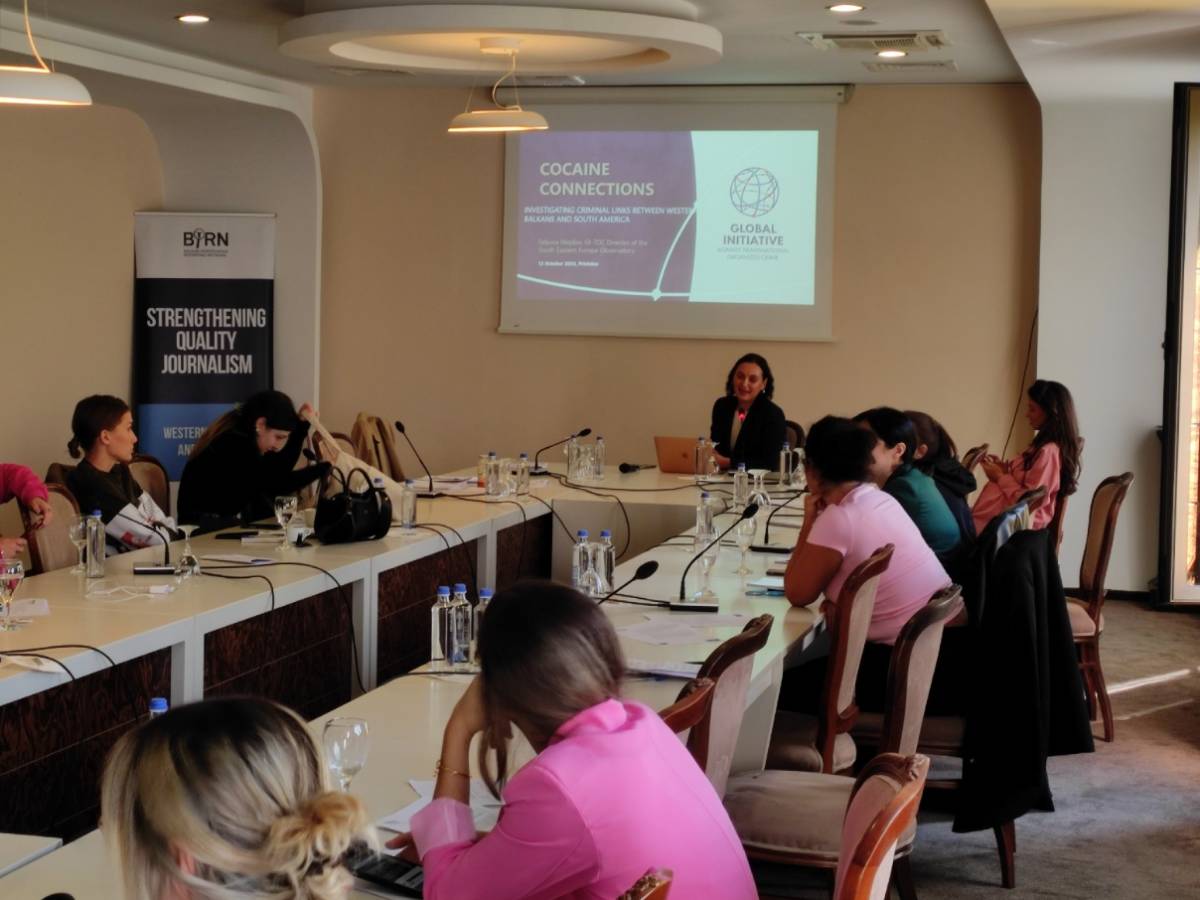
BIRN Kosovo Holds Investigative Journalism and Fact-Checking Training

BIRN Kosovo held a three-day training course on investigative journalism and fact-checking with regional and international experts in Prishtina, Kosovo from October 11 to 13.

A total of 18 journalists from Albania, Kosovo, Serbia, and Bosnia, 14 of whom were women, attended.

Over three days, the participants became familiar with fact-checking and verification tools and studied in-depth investigations from the region.

The first day started with an introduction to the training and project given by Arita Suhodolli, Program Manager at BIRN Kosovo.

The first session was held by Visar Prebreza, managing editor of investigations and fact-checking at KALLXO.com, who spoke about the critical role of investigative journalism in holding powerful individuals and institutions accountable.

Participants learned more how impactful reporting can expose corruption and influence tangible change, with a special focus on case studies of high-profile investigations made by KALLXO.com that led to arrests and legal action.

The second and third sessions were held by Ximena Villagrán, Chief Operating Officer at Maldita.es.

She addressed the global challenges posed by disinformation, where sensationalism and clickbait often dominate the media landscape, undermining the credibility of fact-based journalism. This session explored the crucial role that fact-checking and investigative journalism play in countering false narratives and fostering resilience against malign influences.

Ximena Villagrán spoke also about the innovative tools for engaging younger audiences together with her colleague, Alba Moreno, who spoke about the Factous page launched by Maldita.es itself, a social media page mainly on Instagram, Tiktok and YouTube Shorts.

This initiative aims to guarantee access to information for all people, and awaken the interest of young people in issues that affect them most: politics, economy, culture.

According to them, the page was launched to provide citizens with reliable content based on evidence, facts and data that refutes misinformation and addresses citizens’ information queries with varied and accessible formats, creating a more resilient, accessible and reliable information and media ecosystem.

Moreno explained that the objective is to bring current events closer to younger people using friendly and informal language but without neglecting rigour.

The second day continued with Ylli Buleshkaj, Director of the Agency for Prevention of Corruption, who spoke about the role of whistleblowers and how to protect them.

Buleshkaj gave best practices of protecting whistleblowers based on legal principles and models from regulatory bodies.

The second session was held by Faik Ispahiu, Executive Director of Internews Kosova and TV Producer, who spoke about the art of visual storytelling in TV investigations, showing how to combine compelling narratives with engaging visuals.

Ispahiu spoke also about the creation of a media platform using information technology where citizens can report on corruption and organised crime and the protection of whistleblowers within organised crime groups and cross-border crime.

The fourth session was held by Xhorxhina Bami, editor and journalist at BIRN, who spoke about her investigations on cyberbullying networks within the Balkans including the protection and security of journalists while reporting on the topic and the case of weapons confiscated during the Banjska attack in Kosovo in 2023.

The third day started with a session on tackling inter-ethnic disinformation  from Russia and China within the region, held by Dren Gerguri, lecturer at the University of Prishtina’s Department of Journalism.

He also spoke about the online tools that are being used by AI to identify manipulated materials and news spread online.

Fatjona Mejdini, Director of the South Eastern Europe Observatory, Global Initiative Against Transnational Organized Crime, spoke about her in-depth investigation of drug networks from Ecuador in Europe and Western Balkans.

The training closed with a presentation by Arita Suhodolli, Program Manager at BIRN on the Fellowship program.

The training course was held as part of the EU-funded project Strengthening Quality News and Independent Journalism in the Western Balkans and Turkey II.

Kosovo’s Radio Gorazdevac, Long-term Partner of BIRN, Celebrates 25 Years

Small radio station that punches above its weight marks an important anniversary and reflects on future goals and challenges.

Radio Gorazdevac, a respected local media outlet and current grantee of the “Western Balkans Media for Change” project, celebrated its 25th anniversary by hosting a media conference.

Gorazdevac may be a small village in southwestern Kosovo but for the past 25 years a local media outlet has been independently putting it on the map of a divided society.

Radio Gorazdevac celebrated its anniversary on October 10 at the local Cultural Centre, transforming the event into a small “media festival,” as its editor-in-chief, Darko Dimitrijevic, humbly but proudly remarked.

The conference drew journalists, NGOs, and speakers from diverse backgrounds, speaking both Albanian and Serbian among others.

BIRN and Radio Gorazdevac are long-term partners in two projects delivered in cooperation with British Council, Intrac and Thomson Media.

The Media 4 All project has significantly improved the station’s reporting quality and internal capacity, particularly by bringing young people onto the team.

Thanks to the Western Balkans Media for Change project, Radio Gorazdevac has expanded into new formats, such as podcasts, and has continued using the Engaged Citizens Reporting tool, provided and developed by BIRN as part of the Media 4 All project, to encourage citizen involvement in reporting. Its “E-reporter” page now invites citizens to report issues in their communities proactively.

Dimitrijevic has been with Radio Gorazdevac since its birth in the aftermath of the Kosovo war in 1999. Since then, he has witnessed the station’s struggle to report in Serbian and bring community stories to light, despite daily challenges.

“I was really surprised by the turnout of more than 80 people in small Gorazdevac, including representatives of the international community. This event is the crowning achievement of our work, and it shows what we’ve accomplished as a small local media outlet in Kosovo,” he said.

Among those who congratulated Radio Gorazdevac was Maja Sever, President of the European Federation of Journalists. In her video message, Sever said: “Only those of us from this region know how successful it is and what it means to survive and work as an independent journalistic radio station for so many years.”

Over time, Radio Gorazdevac has expanded to include a small TV production, and, with the growth of the internet, it has established a strong online presence.

“Many people learn about local events thanks to Radio Gorazdevac. We address the problems citizens face with institutions, and often citizens reach out to us directly to report issues in their daily lives. We’ve earned their trust but the path has not been easy, especially considering the challenging political climate in Kosovo,” Dimitrijevic added.

To celebrate its anniversary, Radio Gorazdevac organised a conference with two panels. The first discussed the role of local media outlets in an era dominated by social media. The second focused on crisis reporting and the safety of journalists, especially given the daily online and physical threats faced by independent journalists in Kosovo.

“What would happen if Radio Gorazdevac didn’t exist, producing news for the local community?” asked one of the panelists, Ardita Zejnullahu, director of the Association of Broadcast Media in Kosovo, AMPEK.

“People would likely turn to social media where misinformation and disinformation are rampant. The average citizen doesn’t fact-check what they see in these spaces. This poses a significant risk, as highly politicised communities form when there are no local media outlets to produce, verify, and deliver credible information,” Zejnullahu noted.

Ana Marija Ivkovic, journalist and editor at Alternativna and a civil activist from Northern Kosovo, highlighted the challenges local media face in reporting crises and obtaining accurate information amidst a sea of misinformation.

“We have a huge responsibility to report on crises, even though we are often not trained for it. We do the best we can,” she said.

The panelists agreed that media outlets are a powerful tool in combating misinformation and disinformation but acknowledged the challenges they face.

“There are only a few media outlets and journalists in Kosovo that can truly be called independent. In my opinion, local media outlets are the bravest when it comes to independent reporting,” said Andjelka Cup, editor-in-chief of Gracanica Online.

The conference also provided an opportunity for Radio Gorazdevac to reflect on its future direction.

“Media 4 All and Western Balkans Media for Change are programmes that have helped us grow and I can already see the direction we’ll evolve in the coming years. This progress is a result of the project funding, training and mentorship we’ve received from BIRN over the years,” Dimitrijevic concluded.

Visar Prebreza, BIRN investigative journalist and a mentor to Radio Goraždevac as part of the Western Balkans Media for Change project, praised the station’s commitment to journalism.

“They have also been proactive in finding media partners to produce regional stories, recognising that many issues in the Balkans are shared and require the collective efforts of all countries to be addressed,” she said.

“I believe the project has contributed to enhancing the radio’s professional and technical capacities, bringing it closer to the public while also enabling it to evolve in line with modern times and competitive media,” Prebreza remarked.

BIRN Serbia Wins Three EU Awards for Investigative Journalism

Gordana Andric, Aleksandar Djordjevic, Andjela Milivojevic and Radmilo Markovic received awards for stories investigating embezzlement through public competitions, illegal constructions in Belgrade and image-based sexual abuse of women.

BIRN journalists were awarded with three prizes at the ninth annual EU Investigative Journalism Award on October 9 in Belgrade.

The first prize went to a team from the Center for Investigative Journalism of Serbia (CINS) – Ivana Milosavljevic, Teodora Curcic, and Vladimir Kostic – for their investigation “CINS in SNS Call Center: Hostess Agency, Vote Buying, and Millions in Cash.”

Gordana Andric and Aleksandar Djordjevic of BIRN received second prize for their investigation into a widespread network of individuals who embezzled millions of euros from the state budget through public competitions, exposing systemic failures in the mechanism intended to fund public interest projects.

The third prize was shared by Radmilo Markovic, for his investigation into illegal construction and legalisations, and Andjela Milivojevic for her work on image-based sexual abuse of women.

Markovic’s article on illegal construction reveals years of systemic legal violations by investors and municipal authorities in Belgrade. Hundreds of new buildings constructed without permits during and after 2015 were legalized without legal grounds. This process led to the legalization of nearly half a million square meters, damaging the public budget, and damaging the quality of life in the capital while enriching a few individuals. In his months-long investigation, Markovic identified over 300 buildings with a total area exceeding 450,000 square meters that were legalized without clear legal justification.

Milivojevic, in her investigation of the devastating impact of unauthorized sharing of women’s intimate photos, interviewed over 25 women and girls from Serbia about the shock, fear, and shame they experienced. She also mapped out 16 groups on the social media platform Telegram that shared private photos and videos of Serbian women, with the largest group having almost 50,000 members.

This year’s jury included journalist Ljubica Gojgic, the Secretary General of Independent Journalists’ Association of Serbia Tamara Filipović Stevanovic, and Perica Gunjic, editor of Cenzolovka.

The EU Award for Investigative Journalism was established in 2015. It is given for outstanding journalistic efforts in six Western Balkan countries and Turkey, promoting media freedom and highlighting the importance of investigative work in countries where independent media play a crucial role.