BIRN Montenegro Holds Forum on Corruption in Transport Companies

On November 27, BIRN Montenegro held an Anti-Corruption Forum, “Corruption in Transport”, which concluded that state-owned transport companies must increase their transparency in order to reduce the risk of corruption in their operations.

At the forum, BIRN Montenegro presented its report on the spending of state-owned transport companies, which showed that most of them operate non-transparently.

BIRN Montenegro’s executive director, Vuk Maras, said the majority of state-owned companies continued to withhold business information even after the change of government in 2020.

“All of this leads us to suspect that political corruption established by the previous regime is still present in practice. The former government used state-owned companies’ resources in various ways to buy votes, and the extent of abuses has only expanded with the arrival of the new authorities,” Maras said.

During its eight months of monitoring, BIRN Montenegro tracked the spending of eight state-owned transport companies: Airports of Montenegro, the national airline ToMontenegro, Monteput, Montecargo, Port of Bar, Port of Kotor, Crnogorska Plovidba in Kotor, and Barska Plovidba.

Montenegro’s Deputy Prime Minister for the Political System, Justice and Anti-Corruption, Momo Koprivica, said that corruption in the transport sector harms not only the state budget but also the safety of citizens.

Minister of Transport Maja Vukicevic said there must be institutional accountability for corruption, noting that documents indicating possible corruption have been forwarded to the Special State Prosecutor’s Office.

During the forum, the heads of state-owned transport companies said they will increase transparency in their operations and optimise company expenses. They stressed that it is becoming increasingly difficult to find qualified workers, while at the same time they have an excess of administrative staff who do not contribute to the functioning of the system.

BIRN Montenegro Report Reveals State Firms’ Abuse of Severance Payments

On November 26, BIRN Montenegro presented a monitoring report showing that state-owned transport companies are exploiting loopholes in the law to misuse severance payments.

Over the course of eight months, BIRN Montenegro monitored the spending of eight state-owned transport companies – Airports of Montenegro, the national airline ToMontenegro, Monteput, Montecargo, the ports of Bar and Kotor, as well as Crnogorska Plovidba and Barska Plovidba.

BIRN Montenegro’s Programme Manager, Jelena Mitrovic, said that legal gaps in Labour Law give company managements broad discretion in determining severance payment amounts.

“This enables companies, through internal acts and decisions, to award amounts significantly higher than those prescribed by law, which may suggest a political background to the signed agreements on voluntary termination of employment,” Mitrovic said.

The BIRN report showed that state companies spent more than 1.3 million euros on severance payments, while more than 1.2 million euros was spent on donations and sponsorships.

BIRN Montenegro’s Executive Director, Vuk Maras, said that only three companies provided all the requested documentation, while some submitted incomplete data.

“Monteput submitted part of the documentation only after BIRN concluded its research, while Luka Bar classified a portion of the requested documents as a business secret,” Maras said.

BIRN Montenegro analyzed over 1.400 datasets, spanning over 6.000 pages of documents, which resulted in creation of a database with more than 9.000 entries. It is available at https://birn.me/projekti/izvjestaj-o-monitoringu-potrosnje-sredstava-od-strane-regulatornih-i-drugih-subjekata-od-posebnog-znacaja/

BIRN Montenegro Report: Regulatory Institutions’ Spending Far from Transparent

Tracking of seven institutions over four months showed most of them were not transparent about their spending of public money.

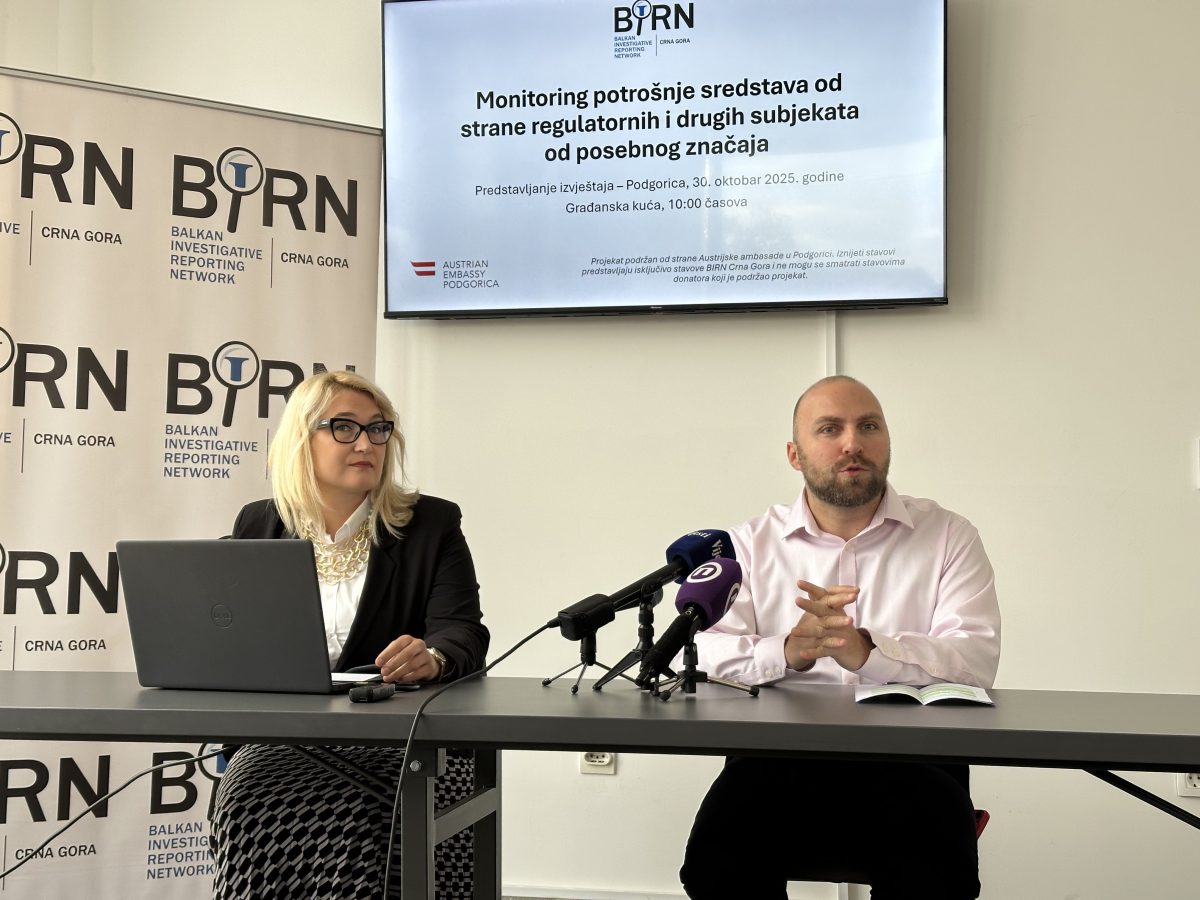
On October 30, BIRN Montenegro presented a report on the spending of funds by regulatory and other institutions of special importance, which showed that most of them lack transparency when it comes to the use of public money.

During a four-month monitoring period, BIRN Montenegro tracked the spending of seven regulatory agencies: the Agency for Electronic Communications and Postal Services (EKIP), the Energy and Regulated Utilities Agency (REGAGEN), the Insurance Supervision Agency, the Civil Aviation Agency, the Capital Market Commission, the Institute for Medicines and Medical Devices (CINMED), and the Development Bank of Montenegro (formerly known as the Investment and Development Fund).

BIRN Montenegro’s Executive Director, Vuk Maras, warned that the majority of monitored agencies failed to demonstrate transparency, adding that the report will be presented to the relevant institutions to ensure that those enjoying institutional independence truly operate independently.

“We took part in consultations with the State Audit Institution (SAI), which has been informed about all the findings identified by BIRN during this period. We will also address the government of Montenegro and the relevant line ministry. All the entities and institutions within this chain of control and oversight will be informed about the problems we identified, and we hope they will take all necessary steps to correct these irregularities,” Maras said.

BIRN Montenegro’s Programme Manager, Jelena Mitrovic, pointed that over a six-year period, the agencies generated more than 191,8 million euros in revenues, while spending 73.1 million euros on salaries, allowances, and other personal expenses.

“In the six-year period, just over 542,000 euros was distributed for sponsorships and donations, with the largest share allocated by the Institute for Medicines and Medical Devices, without any available information on the recipients. That institution alone granted more than 438,000 euros last year for housing assistance, which is nearly five times more than in 2023,” Mitrovic said.

BIRN Represented at European Media Freedom Summit

BIRN Serbia Director Dragana Obradovic and an editor of Balkan Insight, Hamdi Firat Buyuk, spoke at the Media Freedom Rapid Response Summit in Brussels.

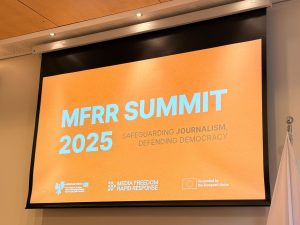
Dragana Obradovic, Director of BIRN Serbia and Hamdi Firat Buyuk, an editor with BIRN’s flagship publication in English, Balkan Insight, attended the Media Freedom Rapid Response, MFRR Summit 2025 in Brussels on October 13.

Obradovic told a panel entitled “Spoofing, Surveillance, Spyware. Journalists against Digital Threats” about BIRN’s own experience of digital threats. “We have seen it all. We have decided to fight back. We decided not to be victims,” Obradovic said.

She underlined that digital autocracy came to Serbia some 10 years ago. “Digital tech, including spyware, were misused in Serbia, including those that were bought by the government or bought by international donations,” Obradovic said.

She said the digital threats had escalated since 2023, “when Serbia entered a political crisis, and even more in the last year, when major public demonstrations started all over the country.

“Most of the targeted people are students, journalists and activists. Journalists are not the only target, but journalists are more resilient because they are more prepared, and citizens and activists are more prone to digital threats,” she added, recalling BIRN’s programme and projects on digital rights.

“[At BIRN], we followed digital rights violations very closely with monitoring tools, as well as public procurement monitoring,” she said.

Another speaker from BIRN, Buyuk, presented the grim media situation in Turkey.

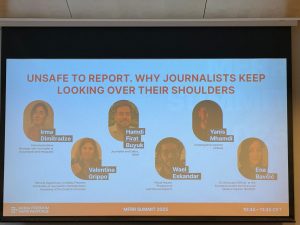
“Attacks on journalists come with an advance tactic that includes multiple tools, including arrests, judicial harassment, access blocks and digital violence” Buyuk told a panel entitled “Unsafe to Report. Why Journalists Keep Looking Over Their Shoulders”.

Buyuk underlined that the online attacks in Turkey against journalists are unprecedented.

“More than a million online content items were blocked in Turkey in 2024. This includes 5,740 that were news content or media houses’ websites. Big tech companies increasingly yield to the demands of the Turkish government, eyeing profit rather than press freedom and freedom of speech,” Buyuk said.

The Media Freedom Rapid Response, MFRR, is a Europe-wide mechanism, which tracks, monitors and reacts to violations of press and media freedom in EU Member States and Candidate Countries.

The MFRR Summit 2025 brings together journalists, policymakers, and civil society to address the urgent challenges facing press freedom in Europe.

This year’s summit feeds into EU Democracy Shield policy discussions, and highlights journalism as vital democratic infrastructure.

BIRN Montenegro Journalist Wins EU Journalism Prize

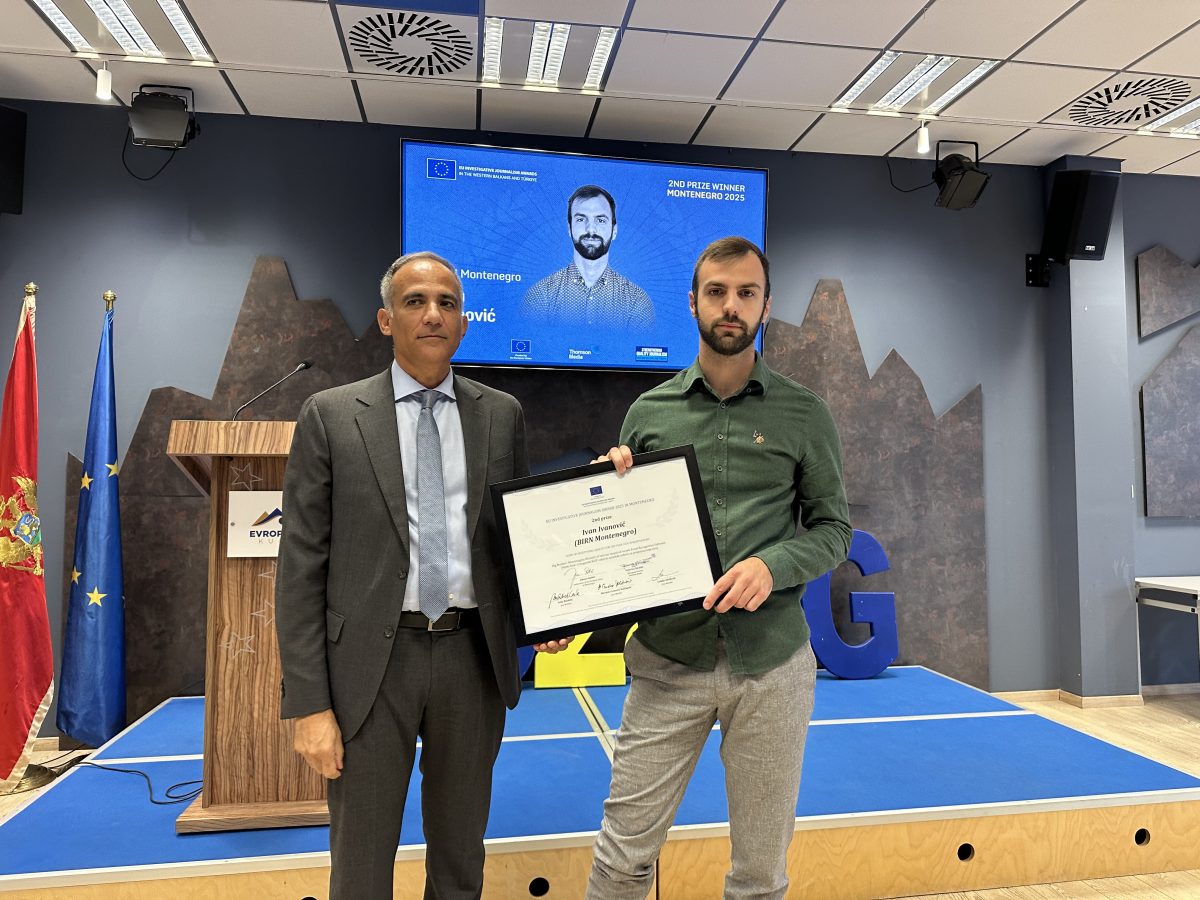
BIRN Montenegro journalist Ivan Ivanovic won second prize at the EU Award for Investigative Journalism 2025 on Wednesday.

Ivanovic received the award for his story Big Brother: Montenegro’s Interior Ministry purchased Israeli facial recognition software’. BIRN’s investigation revealed that Montenegrin Interior Ministry bought a facial recognition software product called ‘Better Tomorrow’ and deployed it in public spaces in the capital Podgorica and the coastal towns of Bar and Budva.

Following the story’s publication, the Agency for Personal Data Protection banned the use of the software.

“This investigation was the result of several months of work involving the analysis and processing of documents obtained mainly through freedom of information requests, which once again proves how essential this tool is for investigative journalism,” Ivanovic said.

The second prize was shared by daily Pobjeda journalist Jovan Nikitovic for his investigation of abuses during the reconstruction of a museum in the town of Bijelo Polje.

The first prize was awarded to TV channel Vijesti for the documentary ‘Target: Montenegro – A State of Relatives’. The documentary investigates cases of relatives of state and local officials being employed within the public administration.

The third prize went to Podgorica-based anti-corruption NGO, ‘MANS’ for its investigation into the assets of former National Security Agency official Dusko Golubovic.

The competition recognised the best investigative stories published in Montenegro during 2024, with 34 entries submitted.

Montenegro Withdraws Security Agency Law Proposal After Criticism

On July 30, Montenegro’s ruling majority withdrew the draft Law on the Agency for National Security, ANB, after the civil sector warned that it endangered democratic standards, the rule of law, and human rights in the country.

Parliament Speaker Andrija Mandic said the draft law needed to be better communicated to the public and to international partners.

On July 29, BIRN Montenegro’s Executive Director, Vuk Maras, urged the European Commission, NATO, and the Council of Europe to call on the Government of Montenegro to halt adoption of the draft Law on the ANB, warning that the proposal had been prepared without proper consultations, transparency, or legislative safeguards.

The same day, the European Commission Spokesperson for Enlargement, International Partnerships and the Mediterranean, Guillaume Mercier, told the daily Vijesti that the European Commission expected Montenegro to allow it to conduct a thorough analysis of the law before proceeding with the adoption process.

More than 20 leading non-government organisations in Montenegro have called on the Government to withdraw the draft law from procedure so it can be aligned with the Constitution and international standards.

BIRN Montenegro Urges Halt to Security Agency Law Over Threat to Democracy

On July 29, BIRN Montenegro’s Executive Director, Vuk Maras, urged the European Commission, NATO, and the Council of Europe to call on the Government of Montenegro to halt adoption of the draft Law on the Agency for National Security (ANB), as it seriously threatens democratic standards, the rule of law and human rights in Montenegro.

Maras sent the letter to the European Commission President, Ursula von der Leyen, High Representative for Foreign Affairs and Security Policy, Kaja Kallas, European Commissioner for Enlargement, Marta Kos, NATO Secretary General, Mark Rutte, Council of Europe Secretary General, Alain Berset, and Commissioner for Human Rights, Michael O’Flaherty, warning that the law proposal was prepared without proper consultations, transparency, or legislative safeguards.

“Key concerns of the draft law include access to databases and information-communication systems without prior judicial approval, implementation of some secret surveillance measures without a court order and lack of any procedure for employment in the Agency. While we are aware that some democratic countries do have some of these solutions incorporated in their systems, the Montenegrin context makes such discretionary rights highly problematic,” Maras said.

He recalled that significant cases of misuse of surveillance of civil society, opposition, or media without proper judicial authorization are currently being adjudicated, including cases against a former Security Agency Director, Dejan Perunicic.

Maras stressed that Agency had never undergone systemic reform, or proper vetting of its current staff, and no accountability by its employees involved in illegal operations has ever been established.

“Considering these concerns, we respectfully request that NATO, the European Commission and the Council of Europe encourage suspension of any adoption of the draft law in its current form, facilitate or insist on a proper, participatory legislative process, and support introduction of proper judiciary oversight and scrutiny and independent review channels for alleged abuses,” Maras said.


BIRN Montenegro Launches Regulatory Watchdog Project

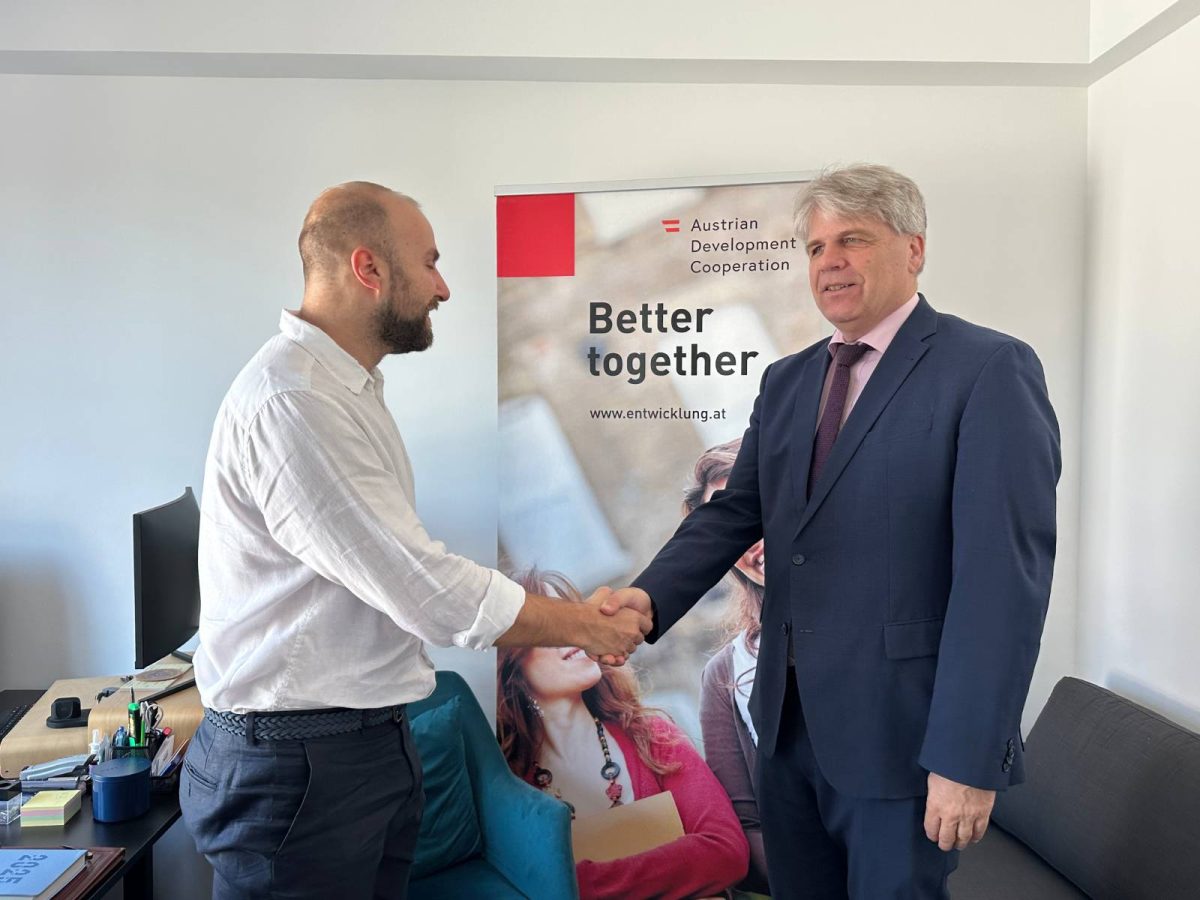
On July 21 the Austrian Embassy in Podgorica concluded an agreement with BIRN Montenegro on support for a project on monitoring the transparency and accountability of various regulatory institutions in Montenegro.

The project, “Regulating the Regulators”, is part of a wider effort to make institutions more transparent, credible and accountable, as Montenegro prepares for accession to the EU.

The contract was signed by Austria’s Ambassador to Montenegro, Dr Christian Steiner, and the Executive Director of BIRN Montenegro, Vuk Maras.

Last July, BIRN Montenegro published a report on spending by state-owned electricity companies, which revealed an increase in the number of their employees, as well as abuses in the allocation of sponsorships and donations.

BIRN Montenegro is currently monitoring the spending of state-owned transport companies.

Montenegro’s State Audit Institution Confirms BIRN Report Findings

On July 2, the Montenegrin State Audit Institution, DRI, confirmed the findings of BIRN’s report about the lack of transparency in hiring and financing at the state-owned energy company EPCG-Solar gradnja.

The BIRN report revealed, among other findings, a significant increase in the number of employees across several companies, as well as more than 6.5 million euros distributed in donations and sponsorships.

On completion of its monitoring, BIRN Montenegro addressed DRI with its findings, suggesting that EPCG-Solar Gradnja be included in the 2025 audit plan.

In its annual report, the DRI said the management of EPCG-Solar gradnja hired 357 employees in 2024 without issuing public calls and increased employee salaries without consulting the government and the Ministry of Energy, which is a legal obligation.

The report says the energy company failed to meet its legal obligation to reduce the total salary fund by 10 per cent after recording a 2.7-million-euro loss in 2023. The DRI submitted its report on irregularities in the company to the Supreme State Prosecutor’s Office, parliament and the Ministry of Finance.

Over the seven-month monitoring period, BIRN Montenegro tracked the spending of five state-owned energy companies: the Electric Power Company of Montenegro, EPCG, the Montenegrin Electric Distribution System, CEDIS, the Montenegrin Electric Transmission System, CGES, EPCG- Solar gradnja and EPCG-Zeljezara Niksic.

These companies were selected for monitoring due to widespread public speculation that those leading them were using their funds for political purposes.

BIRN Montenegro Holds Training on Crypto Investigations

On June 9, BIRN Montenegro organised a capacity-building programme, titled “State Threats in Digital Assets: Assessing the Malign Influence”, in Budva, presenting investigative models for tracking cryptocurrency use in the context of financial crime.

During the two-day training for journalists, civic activists and IT experts, Israeli crypto expert Amit Levin presented models of how cryptocurrencies can be misused for money laundering and suspicious transactions.

Levin introduced participants to the fundamentals of blockchain technology and provided an overview of cryptocurrencies in the context of financial crime. He presented models explaining why virtual assets are appealing to illicit actors and demonstrated methods to trace basic transaction flows and identify linked addresses.

Levin is a former prosecutor in Israel’s State Attorney’s Office, where he led the Economics Department of the Cyber Unit. He prosecuted cases involving money laundering and terrorist financing using virtual currencies.

During the training, participants also shared ideas for investigative stories and a policy paper on threats posed by digital assets and malign foreign influences.

On June 14, BIRN Montenegro organised a follow-up training for representatives of the state prosecution and judiciary during which Levin presented models of financial investigations involving cryptocurrencies in Israel. This training was organised in cooperation with the Centre for Education in Judiciary and State Prosecution.