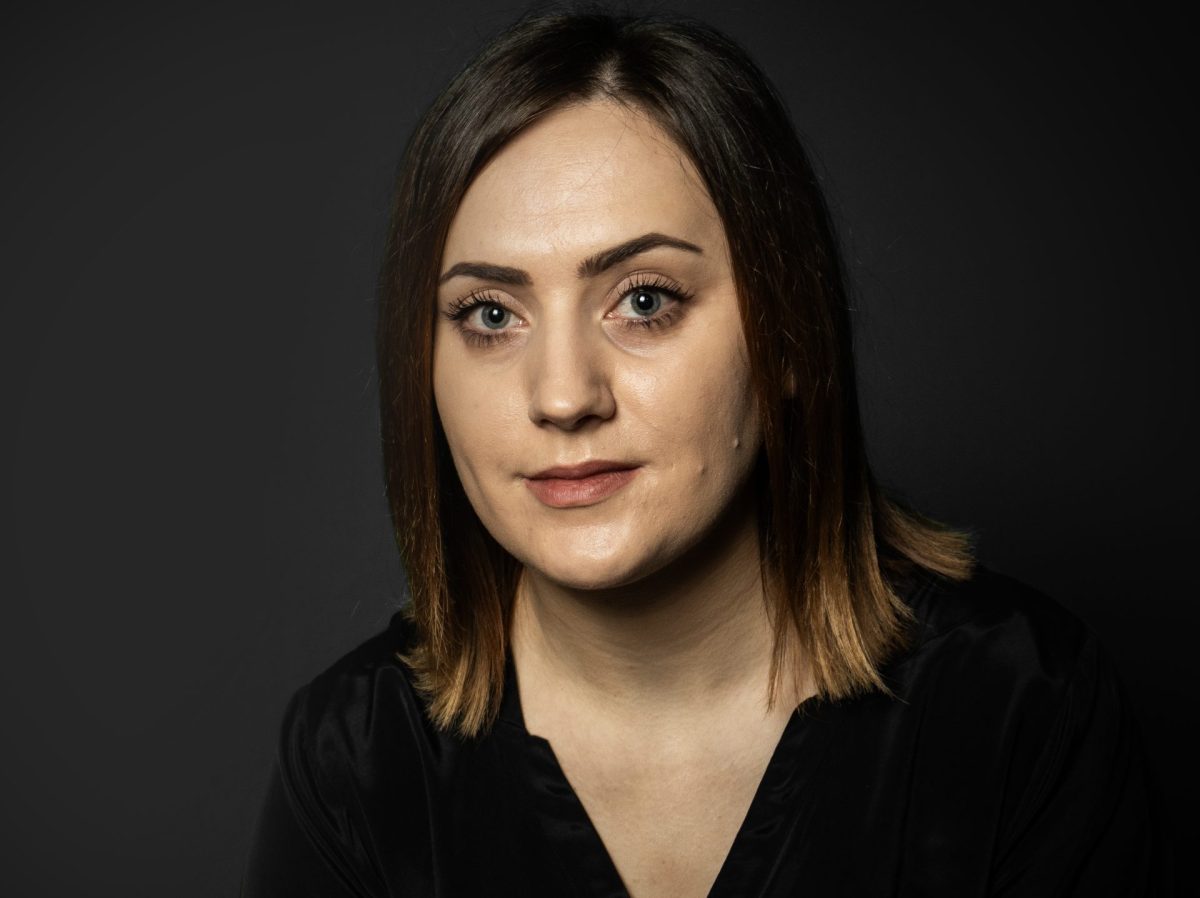
Verona Zymberi

Verona joined the BIRN team in July 2023, marking her first experience as a journalist.

She is currently studying in the Department of Journalism at the University of Prishtina.

Her work primarily focuses on local governance, with a particular interest in education, although her reporting also covers other sectors.

Journalism wasn’t her childhood dream but became a passion during her teenage years, which quickly turned into her profession.

Believing in the media’s role in society, she prioritizes fair and ethical reporting in her work.

Rexhep Maloku

Rexhep Maloku joined BIRN in July 2024 as a journalist and translator.

With a journalism career starting in 2007 at KOHA Group (Koha Ditore, KTV, koha.net), he worked as a feature journalist, international news translator and editor, and host of the Cosmo show until May 2023. Between 2009–2013, he taught English in Ferizaj schools, and from 2015–2017, he translated news for dialogplus.ch.

He served as Program Manager at INPO in Ferizaj (June–October 2023) and has been a journalist at Tema and a contributor to Kosovo 2.0 since November 2023.

Rexhep holds a bachelor’s degree in Journalism from the University of Prishtina in AAB College, where he is completing a master’s in Public Administration and Diplomacy.

Passionate about international relations and storytelling, he combines journalism and translation to explore global narratives. Known for quoting García Márquez on journalism and literature, he’s equally unwavering in his Arsenal fandom, despite the team’s long title drought.

Iliria Kajdomqaj

Iliria Kajdomqaj joined the BIRN team in October 2023 as a Project Coordinator.

She holds a bachelor’s degree in Political Science from the University of Prishtina and is completing her master’s studies in European Integration and Public Administration at the same institution.

Her experience is closely tied to initiatives and projects in governmental and non-governmental capacities with an emphasis on transitional justice and dealing with the past.

With a unique name, a positive attitude, and full dedication, Iliria has a passion for reading and poetry. A former basketball player and a loyal Arsenal fan for two decades, she is, in other words, both faithful and patient.

Florinda Kelmendi

Florinda completed her studies in “Media and Communication” at the University for Business and Technology, where she dreamed about becoming a journalist.

In July 2023, she began as an intern at BIRN and soon after became a                junior journalist.

Her focus lies in local governance in the municipalities of the North and South, monitoring court sessions, and reporting on other sectors related to the Mitrovica region.

Florinda has participated in journalism training programs, including KALLXO Rinia and the School for Investigative Journalism – Çohu.

She is known for her positive personality and persistence in obtaining answers.

Arbrita Uka

Arbrita Uka began her career as a journalist at BIRN in March 2023.

She is studying Physics and is passionate about Astronomy. Her curiosity and drive for research led her to pursue journalism. Previously, she was engaged in volunteer work and led youth groups in Kosovo.

In March 2022, she represented Kosovo at the Youth Congress for Environmental Education in Prague. Known for her honesty and attention to detail, she firmly believes that humanity has landed on the Moon and that the Earth is not flat. She enjoys stargazing, either with the naked eye or through a telescope, and is a devoted fan of the football team Liverpool.

Agron Halitaj

Agron Halitaj has worked in journalism for over 20 years. He joined the BIRN team on February 1, 2024.

Throughout his career, he has worked as a political journalist and has held senior editorial positions in several media outlets in Kosovo. He is an opinion writer and an award-winning journalist. He defines the role of journalists in society with Frans Timmermans’ saying: “If journalists fall silent, our freedom is lost.”

BIRN Kosovo Holds Training on Property Rights and Registration

BIRN Kosovo organised one-day trainings over December in Prishtina, Prizren, Mitrovica, Gjilan and Ferizaj for journalists, public relations officers and influencers on property rights and procedures for property registration.

During December, 80 participants have taken part in the five municipalities.

The first part of the training addressed common property problems and the legal bases that regulate property issues.

The second part of the training focused on changes to the Cadastre Law and the management of Cadastre Offices, the right of access to property information and the provision of information on property matters relating to the Law on Privacy and the Law on Cadastre.

Session leaders were Kreshnik Gashi, editor-in-chief at KALLXO.com and Labinot Leposhtica, a legal expert.

BIRN will hold similar trainings in Peja and Gjakova over December.

The sessions are aimed at developing the capacity of journalists, influencers and local media – including editors and public relations officers as well as communication officers – on the new Law on Cadastre, contracts for the purchase and sale of movable real estate, the procedures for property registration and reporting on these issues.

This activity is part of the Public Information and Awareness Services for Vulnerable Communities in Kosovo PIAKOS project, in which BIRN acts as a co-implementing party.

The project is financed by the World Bank/State and Peace Building Trust Fund.

BIRN Kosovo Presents Report on Challenges to Terrorism Prevention Strategy

New report looks at national counter-terrorism strategy and assesses whether early intervention mechanisms are working.

The Balkan Investigative Reporting Network in Kosovo, BIRN Kosovo, has published a new report, “Challenges of Terrorism Prevention Mechanisms in Kosovo”, presenting Kosovo’s problems in preventing and combating extremism and terrorism.

The analysis is supported by the Global Community Engagement and Resilience Fund, GCERF, as part of the Resilient and Inclusive Community Programme.

The report looks at implementation of the national strategy and examines the development of an early intervention system to protect individuals at risk of radicalization and assesses the impact of government and non-government efforts in preventing violent extremism.

The findings of the report are the result of six months of research and monitoring work in 26 municipalities, including interviews with relevant stakeholders in Kosovo.

Speakers at the launch were: Xhelal Sveçla, Minister of Interior and National Coordinator for the State Strategy for Preventing and Combating Terrorism; Khalid Koser, founder and director of the Global Community Engagement and Resilience Fund, GCERF, Kreshnik Gashi, editor-in-chief of KALLXO.com, and Labinot Leposhtica.

“Kosovo has joined global coalitions in combating terrorism. Kosovo has taken responsibility for repatriating individuals from Syria, rehabilitating them, and reintegrating them into society. One of the main pillars of our five-year strategy 2023-2028 is the inclusion of local mechanisms and civil society,” Sveçla said.

Koser of GCERF complimented the methods used for the report, such as surveys and interviews, saying: “I believe the methodology makes this a legitimate report that we should take seriously.”

Gashi, editor at Kallxo.com, highlighted the importance of cooperation between civil society and the government in achieving meaningful implementation of the strategy as well as the impact of concrete actions and measures on progressing the situation in Kosovo.

The author of the report, Labiot Leposhtica, noted: “The majority of municipalities, 20 out of 26, reported serious problems in understanding the strategic document (National Strategy). This is a significant issue because the consequences are collateral.”

The 60 participants at the event, 19 of whom were women, included individuals from both central and local government, experts, diplomats, members of religious communities and media representatives.

The report is accessible online here:

AL: Sfidat e mekanizmave të parandalimit të terrorizmit në Kosovë

SRB: Izazovi mehanizma za suzbijanje terorizma na Kosovu

ENG: Challenges of Terrorism Prevention Mechanisms in Kosovo

This activity formed part of the Resilient and Inclusive Community Programme, funded by GCERF.

BIRN Kosovo Trains Journalists to Report on Money Laundering

Two-day workshop was designed to equip journalists with the skills they need to shed light on financial crimes.

On November 29–30, BIRN Kosovo trained 29 journalists and freelancers in Prishtina on ways to enhance their ability to investigate and report on money laundering.

The event, organised by BIRN Kosovo and supported by the UK Foreign, Commonwealth & Development Office, FCDO, aimed to equip journalists with the skills they need to shed light on financial crimes, a critical area often shrouded in complexity.

The training included a diverse lineup of experts, including financial forensics specialists, intelligence officers and prosecutors. The workshop underscored the role of journalism in promoting accountability and transparency, by uncovering financial misconduct.

Day one began with an introduction to the Joint Intelligence Network Against Money Laundering, delivered by Besnik Veseli, from the Tax Administration of Kosovo.

This session set the stage for a detailed examination of money laundering schemes, real-life cases in Kosovo and successful investigative methods drawn from the UK.

Alan Barr and Nick Wilcox, key figures in the UK-Kosovo Anti-Money Laundering Programme, provided insights into the challenges of combating financial crime in the Balkans.

A highlight was a practical exercise led by Visar Prebreza, a financial forensics expert, in which participants worked in groups to apply investigative techniques to hypothetical scenarios.

The day concluded with a working dinner at which Kosovo’s Deputy Chief Prosecutor, Ersan Qavolli, discussed the challenges of tackling money laundering cases.

The second day delved into practical aspects of journalism, with sessions on tracing money laundering through tax and company records and company.

Journalists explored ways to identify high-risk sectors and typologies, analyze case studies and leverage their right to access information under Kosovo’s laws.

In a collaborative exercise, participants explored a fictional case of a company suspected of money laundering. Guided by the experts, they developed strategies to track money flows, draft investigative plans, and identify red flags.

Kreshnik Gashi, editor-in-chief of KALLXO.com, guided participants through the complexities of reporting on money laundering. He led sessions on understanding the right to access information crucial for uncovering financial crimes and on ways journalists can use investigative tools to expose illicit financial activities.

Gashi also explored the consequences of failing to investigate money laundering, shedding light on how unchecked financial crimes can fuel corruption and organised crime.

He emphasized the importance of collaboration between journalists and institutions, highlighting how investigative reporting can hold authorities accountable and empower citizens to demand transparency.

The workshop stressed the importance of journalism in combating financial crime. By providing journalists with the tools to investigate complex cases, it will help to foster a more informed and vigilant media landscape in Kosovo. As financial crime evolves, such initiatives will be key to ensuring transparency and upholding the rule of law.

Meet the People Behind BIRN: Kreshnik Gashi

Kreshnik Gashi is Editor-in-Chief of KALLXO.com (BIRN Kosovo), having joined BIRN in 2012.

He is a law graduate and has won over 20 journalistic prizes for his investigations into corruption and abuse of public duty.

He is the author of over ten in-depth, comprehensive reports on terrorism, corruption, transitional justice, media financing, disinformation and gender-based violence/gender equality in Kosovo.

Recently, he won an EU Award for Investigative Journalism (first prize).

Let’s meet him!

  1. Why did you decide to investigate corruption and abuse of public duty?

My decision to delve into investigative journalism stems from my professional background and aspirations. Having studied law, I initially envisioned a career as a prosecutor focused on serious crimes. However, on entering journalism, I realised the profound impact I could have in uncovering crime and corruption through in-depth investigations. Journalism offered me a broader platform to expose wrongdoing and contribute meaningfully to public accountability. This realisation motivated me to change my focus from prosecution to investigative reporting, where I found both success and personal fulfillment in uncovering systemic abuses of power.

  1. Since joining BIRN, you’ve produced over 300 investigative TV programmes and around 1,000 investigative articles. What do you prefer working on and why?

Corruption and crime are deeply embedded in various aspects of life in the Balkans, making investigative journalism both challenging and crucial. Over the years, I have uncovered organised crime networks spanning from the judiciary to the environment. My preference lies not in the medium, be it TV programmes or articles, but in the completeness of the investigation itself. What drives me is the thoroughness of the research and the precision with which those responsible for misconduct are identified and exposed. This comprehensive approach ensures accountability and empowers the public with actionable knowledge.

  1. How do the results of your work affect you – with over ten prosecutors and judges being arrested and charged, over 30 police officers being arrested and ten indictments of corruption issued for public officials, such as ministers and mayors? What crosses your mind when you look back at these results of your investigations?

Every time I publish a significant investigation, I feel a sense of achievement, often believing that it may be the pinnacle of my career. Yet, experience has shown that each new investigation builds upon the last, raising the standard for what is possible. These results – such as the arrests and indictments – validate the importance of investigative journalism and its role in fostering accountability. When I reflect on these outcomes, I am reminded that the pursuit of truth is an ongoing journey, and there is always more to uncover.

  1. You also hold workshops. Can you tell us more about that?

Professional growth is a cornerstone of my career, and I dedicate considerable time to both attending and delivering advanced training. Each year, I personally attend over 10 specialized trainings in diverse fields. As a certified trainer, I have developed comprehensive programmes on topics ranging from terrorism, money laundering and organised crime to whistleblower protection, identifying disinformation narratives and gender-based violence reporting. My training programmes are tailored to various audiences, including journalists, lawyers, students, and public officials. For specific institutions, such as the police, prosecution, courts, tax administration and customs authorities in Kosovo, I have designed specialised modules on public communication and countering disinformation. These efforts aim to equip stakeholders with the skills needed to navigate complex challenges and enhance transparency.

  1. You and Behar Mustafa recently won the EU Award for Best Investigative Journalism for 2024 in Kosovo (first prize) for your series of investigations into corruption with building permits in Brezovica. So far, you have won over 20 journalistic prizes. What do they mean to you?

Awards serve as both recognition of the hard work behind investigative journalism and as motivation to strive for greater excellence. Winning the EU Award for Best Investigative Journalism in 2024, alongside Behar Mustafa, was a recognition of our dedication to uncovering corruption in Brezovica. For me, these accolades are not just about prestige but also a personal challenge to surpass my own benchmarks. Each award pushes me to innovate, dig deeper, and remain competitive with my peers, ensuring that my work continues to make a meaningful impact.

  1. Which of your stories are you most proud of and why?
    Two investigations stand out as defining moments in my career:

US-Sanctioned Serb’s Company Subcontracts Work to Kosovo Albanians
This investigation uncovered how organised crime groups from Kosovo funneled illicit funds into projects in Ulcinj, exposing the international reach of corruption.

The Appeals Chief Prosecutor Bribery Case
This exposé revealed that the chief prosecutor of appeals accepted a bribe of 300,000 euros, a story that sent shockwaves through the justice system.

These stories exemplify the transformative power of investigative journalism in holding individuals and systems accountable.