Meet the People Behind BIRN: Madalin Necsutu

Madalin has been Balkan Insight’s correspondent from Moldova and Romania since 2017. He is a political and investigative journalist who specialises in Eastern Europe and the politics of ex-Soviet states in the region.

After graduating from the Faculty of History in Bucharest, he joked that he would work as a journalist. But, for about 18 years since he started this job, he still loves what he does.

Let’s meet him!

  1. You graduated from the Faculty of History in Bucharest and completed an MA in International Relations. After that, you completed your postgraduate studies in diplomacy and are doing a PhD in History in Chisinau, Moldova. Still, you’ve been working as a journalist since 2006. What made you become a journalist?

Somehow, this job chose me. At first, it was a joke that a colleague and I would go to work for a newspaper after finishing the degree in History. And so we did. Only it wasn’t in a newspaper, but in the most significant news agency in România at the time – Mediafax. That’s when I started to like the press. We monitored all the print media in Romania every night before the newspapers reached the readers and I liked certain newspapers that were better on the foreign policy side. I joined one of them as a foreign policy journalist due to my History and international relations education. Therefore, my training in foreign policy, research skills, and the field of History helped me a lot, especially when I started practising investigative journalism. It’s driven me to practice this job for about 18 years, and I still like what I do.

  1. Why did you specialize in Eastern Europe and the politics of ex-Soviet states in the region?

That’s a good question. The first newspaper I worked for in Romania, ZIUA, The Day, had one of the best foreign policy editorial offices in Romania, and mainly dealt with Romania’s immediate neighbourhood and the former ex-Soviet space. So, I started to specialize in Moldova, Ukraine and the Russian Federation. In addition, this area, unfortunately, as we see today since the Russian invasion of Ukraine, is up-and-coming for foreign policy journalists. I have also always been interested in the “frozen” conflicts around the Black Sea created by Russia in the former Soviet states.

  1. What has changed in this region for journalism and media outlets in the past few years, especially since the beginning of the war in Ukraine?

Journalists in this area are, first of all, in high demand, and many of them are close to burnout. After the Coronavirus pandemic, journalists from this region almost immediately entered a new crisis – that of the war in Ukraine. So, the last four years have been and are still very difficult for journalists in the vicinity of Ukraine.

Unfortunately, there is news fatigue among journalists and the public regarding Ukraine. The fact that Ukraine is having a hard time maintaining the lines of defence against Russia, and the Western aid has been unacceptably delayed for a long time, is also reflected in the state of the journalists reporting on this area.

The Moldovan media, for example, is still very much subject to Russia’s hybrid war with all its elements of disinformation, fake news, manipulation, etc.

I have noticed another worrying trend in recent years, especially among young journalism graduates not found in newsrooms. On the other hand, I also see many colleagues who have re-profiled in other, less stressful fields. However, there are more opportunities for professional growth through training, development programs, scholarships, and other benefits that journalists enjoy. In other words, there are many less good parts and some opportunities.

  1. In 2016, the Romanian Professional Journalists Union awarded you for your political and investigative stories in Romania, the European Commission awarded you the ‘European Reporter in 2017’ prize, and the UN Development Project awarded you in Moldova in 2016. What do all of these awards mean to you?

Of course, I am happy for each of them. I won all of them with stories on which I worked a lot, some even in dangerous conditions in very unsafe areas or on the edge of wars.

The awards recognise my work but they don’t mean so much to me anymore; they are just nice memories. These prizes only validate the work from that moment. It is a good opportunity to mark some milestones and move towards new ones in my career.

The fact that such awards bring you professional satisfaction simultaneously raises your bar even higher. They also come with responsibilities not to reduce the engines and always try to be your best version. Always work professionally and for the benefit of those who read or follow you on TV screens.

For example, I don’t even participate in some competitions, to give younger colleagues more chances in such contests. I am happy to see their emotions and satisfaction when they receive such awards because I know this will push them to continue in this challenging job.

  1. What Balkan Insight stories are you especially proud of and why?

In seven-and-a-half years of working for Balkan Insight, I have written over 1,200 items, 350 of which were long stories.

One of my favourites was about the cryptocurrencies produced in the separatist Transnistrian region of Moldova with the help of cheap energy obtained from Russia’s supply of free gas. It was tricky and hazardous to get there. However, I created an exciting story about a cryptocurrency production scheme involving some dubious characters from Moldova and Russia.

Another story I liked that I have written in Albania was from a museum of the horrors of communism in Shkoder. I wrote it after a trip to the Balkan region organised by the European Commission. I liked it because, in addition to visiting this earth-shattering museum, I also made many documentaries to understand Albania’s history in the communist era and this whole phenomenon of the totalitarian state. I found shocking similarities with the history of the communist victims in Romania. My training as a historian led me to an in-depth analytical material for a foreigner who writes about Albania in the communist era.

But I have written dozens of stories for Balkan Insight, which in turn have various stories behind them.

  1. What obstacles do you encounter during your work, and what was the most challenging thing you experienced as a journalist?

There are many stories in this sense because I am also an investigative journalist. I’m not an adrenaline junky; I prefer to calculate the risk, not to take it.

However, I often went through dangerous situations during investigations in Moldova’s breakaway region of Transnistria and in Ukraine or in the Middle East on the border with Syria.

There are always obstacles, such as bureaucracy, lack of transparency, bad faith, etc. But as a journalist, you must enter through the window when you are thrown out the door. A good journalist should keep going until he gets what he wants to write in the public interest. The rest is easy and non-involved sort of journalism or PR.

  1. What is one message that you would like to send to young journalists interested in politics?

I would tell them that if they are unwilling to work and do a lot of poorly paid work at the beginning, they might look for another field of activity. If you don’t also have a romantic component of Don Quixote, who fights with windmills, and don’t put the public interest above your disposition to effort and resistance to stress, it’s good to look for something else. Real journalists are strong characters willing to sacrifice a lot of their free time, leave home for whole days, and be reimbursed below their level of training and involvement.

Those unwilling to make such sacrifices at the beginning of their careers are better off not even starting. To the others willing to go through these trials, I advise them to learn continuously, focus on specific aspects/areas/topics, and improve themselves. The most important thing is not to be complacent, to keep an open mind, and to always try new things.

Balkan Journalists Deepen Knowledge on Engaged Citizens Reporting

Over 50 journalists from eight media outlets joined an online ‘learning circle’ on April 22-23 to gain more knowledge about engagement journalism and innovative methods to involve women, young people and under-represented communities in the creation of high-quality content.

The learning circle, entitled ‘Building Foundations for Engaging Citizens in Reporting’, was organised as part of the Western Balkans Media for Change project for media outlets from Albania, North Macedonia, Serbia, Montenegro and Kosovo.

Fifty-three journalists strengthened their understanding of community dynamics, engagement journalism principles and the development of investigative stories based on community involvement.

On the first day, journalists received an introduction to engagement journalism from Corrective, an award-winning, public interest-oriented media company from Germany that aims to strengthen democracy.

Corrective is involved in investigative journalism and seeks to trigger public debate, work with members of the public on their research and promote educational programmes.

In the first session, the journalists explored the emergence of independent local newsrooms that redefine the landscape of journalism production and funding.

They also learned how to actively engage people in their reporting processes, amplify marginalised voices and empower local communities to shape their democratic environments.

Community journalism as a topic was then discussed, showcasing best practices from industry pioneers and strategies for building sustainable business models with community at the core.

The second session focused on presenting a compelling case study titled ‘Suddenly, your body is not yours’ which highlighted barriers to obtaining an abortion in Germany through a crowd-sourced survey.

In the investigation by Correctiv, 1,505 women shared their experiences, shedding light on the systemic failures within the German medical system concerning abortion care.

The second day focused on the development of editorial startegies and best practices to engage communities. In the first session of the second day, the journalists explored editorial strategies for creating engaging content and learned best practices from BIRN.

This part of the learning circle was led by Katarina Zrinjski from BIRN Bosnia and Herzegovina, Besar Likmeta, editor-in-chief at BIRN Albania, and Ana Petruseva, country director of BIRN Macedonia.

The day continued with practical work and ended with a session on using the Engaged Citizens Reporting tool, which BIRN developed through the Media for All project.

The tool enables users to crowdsource data and facilitate engagement with communities. Karla Junicic, BIRN’s ECR Coordinator, presented the tool and its potential for engaging audiences in content creation.

The learning circle formed part of the editorial and mentoring support provided to journalists and media outlets as part of the project. The project provides financial support to media outlets and individual journalists to help them improve operational capacity, business sustainability and innovation potential, while aiming to better equip media professionals to produce more quality diverse, fact-checked and gender-sensitive content that will reach and engage with wider audiences.

The Western Balkans Media for Change project is funded by the UK Government and implemented by the British Council in partnership with the Balkan Investigative Reporting Network, Thomson Foundation and The International NGO Training and Research Centre, INTRAC. It supports the work of media outlets and individual journalists from the Western Balkan countries.

BIRN Investigation Shortlisted for European Press Prize 2024

Story looking at European Commission’s proposal to scan for child sexual abuse material online is one of 25 nominations for prestigious award.

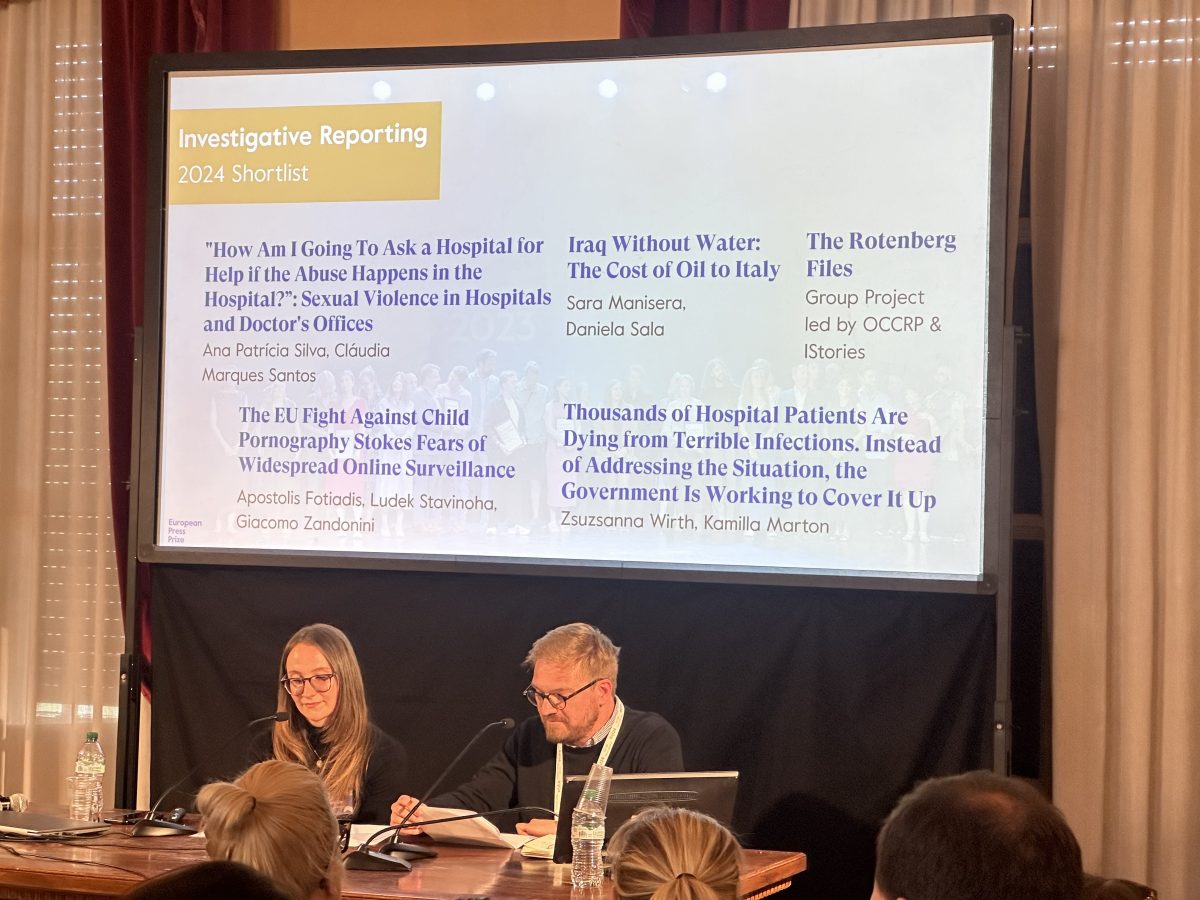
“Who Benefits?’ Inside the EU’s Fight over Scanning for Child Sex Content”, a BIRN investigation, is among 25 stories nominated for the European Press Prize 2024. The nomination was announced on April 19 in Perugia, Italy, during the International Journalism Festival (IJF).

An investigation published on Balkan Insight by BIRN’S investigative editor Apostolis Fotiadis, journalist Giacomo Zandonini and an associate professor in media and international development at the University of East Anglia, Luděk Stavinoha, gained a nomination in the Investigative Reporting Award category.

This investigation uncovers a web of influence in the powerful coalition aligned behind the European Commission’s proposal to scan for child sexual abuse material online, a proposal that experts say puts rights at risk and will introduce new vulnerabilities by undermining encryption.

It was one of the BIRN’s investigations that was most widely republished and cited across Europe – by Le Monde (France), El Diario (Spain), Solomon (Greece), Die Zeit (Germany), De Groene Amsterdammer (the Netherlands), Netzpolitik (Germany), IrpiMedia (Italy), and Domani (Italy), amongst others.

After BIRN published the investigation, the main political groups of the EU Parliament agreed on the draft law to prevent the dissemination of online child sexual abuse material (CSAM). Europol’s in-house research and development centre, the Innovation Hub, has already started working towards an AI-powered tool to classify child sexual abuse images and videos.

This year marks the 12th edition of the European Press Prize – the Awards for excellence in European journalism. The prize received almost 800 submissions from over 40 European countries. More than half of the 25 shortlisted projects tackle the lingering trauma of abuse, the PTSD of war, and the challenges Europe faces addressing mental health issues.

“An important part of the European Press Prize’s mission is encouraging journalists to keep holding power to account by being a source of pride and validation.

“Announcing our 2024 Shortlist at one of the biggest journalistic events in Europe fits in perfectly with that part of our mission. The IJF Perugia is a very fitting festival to celebrate the best of European journalism, together with so many journalists and media professionals – both from the Prize’s Community and beyond,” said Jennifer Athanasiou-Prins, Executive Director of the European Press Prize.

The European Press Prize is awarded yearly in five categories: Distinguished Reporting, Innovation, Investigative Reporting, Public Discourse, and Migration Journalism. The Panel of Judges also awards a Special Award to journalism that defies categories and disciplines. Each award is worth €10,000.

BIRN Became Partner of Journalism Cloud Alliance

The Alliance was launched on April 17 in Perugia, Italy, to democratize access to data storage and promote collaboration among various stakeholders – and so assist investigative reporting worldwide.

The Journalism Cloud Alliance aims to ensure watchdog journalism can perform its public service role by controlling the rising costs and constraints of cloud computing and developing collaborative solutions to collective challenges.

The Global Fund for Media Development (GFMD) and the Organized Crime and Corruption Reporting Project (OCCRP) spearhead the Alliance. Besides BIRN, the partners include Global Investigative Journalism Network (GIJN), International Consortium of Investigative Journalists (ICIJ), Pulitzer Center, Center for Journalism and Liberty, Big Local News, Distributed Denial of Secrets (DDoSecrets), Forbidden Stories, and Arab Reporters for Investigative Journalism (ARIJ), alongside philanthropic and academic organizations.

“The Journalism Cloud Alliance is crucial to building the blueprint for the future of investigative reporting. As journalists, we’re flooded with data we can’t process, analyze, and report on and it’s the public that loses because of this situation. We need to create a data infrastructure that allows us to create more trust with readers and help lead to more robust democracies,” said OCCRP Co-Founder Paul Radu.

Cloud services are infrastructural to journalism today and are likely to become even more important as the amount of data generated increases, as well as AI integration into the newsrooms.

The Journalism Cloud Alliance aims to democratize access to data storage and processing capacity by promoting collaboration among various stakeholders, and to make data resources more accessible and affordable for investigative and data-driven newsrooms worldwide.

Support will be provided to large and small newsrooms. The Alliance also prioritizes fostering accountability journalism and investigative efforts across the scale.

The next steps include conducting detailed cloud capacity and cost research on current and potential members of the Alliance and adding more members to build a robust coalition to secure long-term financial and technical support for these journalism costs.

Building Disinformation Resilience in Montenegro

BIRN Hub

Co-applicant:
n/a

Donor:

CFI – Développement Médias

Short Summary:

The ‘Building Disinformation Resilience in Montenegro’ project will empower BIRN Montenegro, the latest addition to BIRN’s network, to establish a fact-checking unit for consistent coverage of disinformation narratives. As well as strengthening BIRN Montenegro’s capabilities, the project will enhance the skills of local media outlets and their journalists in fact-checking, content verification and accessing information of public interest. This initiative aims to strengthen Montenegro’s resilience against disinformation and misinformation, ensuring the public has access to trustworthy news sources.

Long Summary:

The ‘Building Disinformation Resilience in Montenegro’ project is led by BIRN HUB with the support of CFI – Développement Médias. The initiative aims to build resilience to disinformation by building the capacities of journalists in Montenegro.

Media organisations in most countries in the region, including Montenegro, must navigate highly polarised political environments and face increasing economic and financial uncertainty, along with pressure on editorial independence and even threats from criminal groups. Russia’s continuing war against Ukraine has posed an additional set of challenges for countries trying to contain Russian disinformation efforts while balancing this with upholding media freedoms.

The proliferation of cyber-attacks against government servers in Montenegro during the last year has also caused serious financial damage, halting administrative activities and delaying trials. This not only demonstrates weaknesses in prevention mechanisms, but also contributes to an environment that nurtures speculation and spreads unverified information.

The country has experienced strong political polarisation in recent years, which has resulted in media outlets aligning themselves with specific political agendas. This has led to the propagation of biased, incomplete and even false information that serves these agendas. Key areas where such phenomena have been noted are related to Montenegro’s NATO membership and political, ethnic and religious divisions in the society.

Increased challenges related to disinformation, misinformation and malinformation continue to be dominate social media as well as traditional outlets. Domestic media, which generally tend to cover community issues in a professional manner, lack the capacity to identify, debunk and report on disinformation.

This project will enable BIRN’s network’s newest member, BIRN Montenegro, to set up a fact-checking unit and regularly report on disinformation narratives. As well as building the capacities of BIRN Montenegro, BIRN will also build the capacities of domestic local media outlets and their journalists in fact-checking, content verification, access to information of public interest etc, in order to increase their effectiveness in professional and objective reporting. In this way, Montenegro will be more resilient to disinformation and false information narratives, providing the public with more credible news content.

Through this initiative, BIRN aims to improve the standard of journalism in Montenegro, focusing specifically on combatting disinformation. After the intensive programme, BIRN Montenegro will also be able to serve as BIRN’s focal point for all fact-checking activities related to the country, while also enhancing the capabilities of other organisations in this area. This impact will be increased by building the capacities of domestic media to identify, debunk and report on disinformation.

Target Group(s):

  • BIRN Montenegro journalists
  • BIRN Network – up to 10 journalists from the BIRN Network who collaborate with Montenegrin colleagues
  • Montenegrin youth
  • Journalists and local media

Expected Results:

  • Fact-checking unit in BIRN Montenegro is to be set up, skilled and operational.
  • Montenegrin youth to be better informed about disinformation and false information narratives designed to target them.
  • Local media and journalists to be more capable to identify, debunk and report on disinformation and false information.

Main Activities:

Activity 01. Build capacities of BIRN Montenegro journalists and its correspondents on disinformation and false information through intensive training and mentoring.

Activity 02. Purchase equipment, software and subscriptions needed for fact-checking.

Activity 03. Develop and adopt fact-checking procedures for editorial work.

Activity 04. Develop a detailed production plan for disinformation and false information stories targeting youth.

Activity 05. Conduct extensive consultations with civil society organisations dealing with youth, to identify the most problematic disinformation narratives used to target youth, as well as distribution channels.

Activity 06. Develop, publish and promote at least three in-depth analyses on disinformation and false information targeting youth.

Activity 07. Organise training for journalists from domestic media outlets on disinformation and false information.

Activity 08. Provide mentoring to domestic media outlets and journalists on disinformation and false information.

Global Investigative Journalism Network

PARTNER
The Global Investigative Journalism Network serves as the international hub for the world’s investigative reporters. From its founding in 2003, GIJN has grown to include 250 member groups in 91 countries. Today, with a staff based in over 20 countries, GIJN works in a dozen languages to link together the world’s most enterprising journalists, giving them the tools, technology, and training to go after abuses of power and lack of accountability.

Web: https://gijn.org/

Indira Cular

Indira joined BIRN Hub in October 2023 as a Finance Officer. She is based in BIRN Hub’s Sarajevo office.

Her main responsibilities include providing support for financial and administrative tasks and duties for finance, operations and programme department.

She graduated at the University of Sarajevo, Faculty of Economics. Indira has over 15 years of experience in NGOs and media.

Meet the People Behind BIRN: Behar Mustafa

Behar Mustafa is a court monitor, researcher and journalist for the TV programme Justice in Kosovo.

Before joining BIRN in 2014, he worked in various NGOs and media outlets, including the daily newspaper Koha Ditore, where he served as Vushtrri correspondent, and at Kosova Channel in Mitrovica. Although he has a degree in law, he decided to work as a journalist.

Let’s find out why and let’s meet him!

  1. You graduated in law but work as a journalist. What made you decide to pursue that career?

I started in journalism working as a court monitor and journalist/ correspondent from Mitrovica. Before journalism, I was part of civil society, mainly engaged with youth and women empowerment. I studied Law and this helped me to work in an organisation such as BIRN because of the scope of interest it has in the field of justice. It has been 10 years since I started with BIRN.

  1. What’s it like working in Kosovo as a court monitor and researcher? What is most challenging for you?

Nowadays, it is easier to do the job than when I started a decade ago. Initially, from 2014 to 2015, I worked in Mitrovica, covering mostly trials that were carried out by Mitrovica court, and at that time it was very difficult to get there because the court is located in the northern part of the town and we needed to find ways to go there. It was also very difficult to organise your day as a court monitor because in North Mitrovica the court has only courtrooms; all the staff, including prosecutors, were based in another town, in Vushtrri, some 15 kilometers from Mitrovica. There were cases when we went to Mitrovica to attend a trial, but during the day, we had to go to Vushtrri for any request that our job required us to do.

  1. Last year, you received the ‘Best TV Story of the Year’ award from the Association of Journalists of Kosovo for your ‘Brezovica Dossier’ investigation. Tell us more about it.

Last year our team was awarded “Best TV Story of the Year” by the Association of Journalists of Kosovo, AJK. This was a special moment because my colleagues and I got an award for a story we had been patiently working on for almost three years.

“Brezovica Dossier” aired in September 2023. This investigation was done through a series of publications that show how politicians, businesspeople, and other powerful figures in Kosovo are suspected of bribery related to the construction of villas without any criteria in a picturesque tourist site in Kosovo, which has caused huge environmental damage to the beauty of the mountains in this resort. The prize becomes even more special because prosecutors who investigated the case used our findings as well grounded for their work.

  1. What story/stories that you worked on made you incredibly proud (please insert the link to that story/stories)?

I am mostly proud of my stories from the north, which disclosed cases of smuggling, which resulted in many arrests, but also stories related to tenders given by institutions and the way they have been granted to people and businesses close to the authorities.

  1. What makes a good journalist?

Working always for the truth, seeking and finding the truth, even when it looks difficult and, in some cases, impossible. It is very important to take time analysing the facts in front of you and not to publish anything you are not certain presents the whole truth of the story. We are reporting for the public, and public trust is something sacred in our job, something that makes you a good journalist. Once you misuse that trust, you are done for in this job.

  1. What should any journalist not agree to, especially the young?

Not to accept to report on anything you don’t have enough facts about – and avoid political, religious or ethnic bias.

Western Balkan Journalists trained for Engaging Citizens in Their Reporting

Eighteen journalists from eight different media outlets underwent training to learn innovative methods to engage women, youth and underrepresented demographics, including audiences aged 65 and older, in the creation of high-quality content.

As part of the Western Balkans Media for Change project a Learning Circle titled “Building Foundations for Engaging Citizens in Reporting” for media outlets from Albania, Bosnia and Herzegovina, Kosovo and Montenegro was organized.

Over the course of March 21 and 22, 18 journalists strengthened their understanding of community dynamics, engaging journalism principles, and the development of investigative stories based on community involvement.

On the first day, journalists received insights into editorial strategies and audience involvement best practices from facilitators such as Dzana Brkanic, Deputy Editor at BIRN BiH; Aleksandra Bogdani, Editor at BIRN Albania; Katarina Zrinjski from BIRN BiH; and Besar Likmeta, Editor-in-chief at BIRN Albania.

They shared experiences in implementing various approaches and methodologies to produce high-quality, investigative, fact-checked, gender-sensitive, appealing and innovative content.

The focus of the second day was on Engaged Citizens Reporting, ECR, tool, developed through the Media for All project. The tool enables users to crowdsource data and facilitate engagement with the community. Karla Junicic, BIRN’s ECR Coordinator, presented the tool and its potential for engaging audiences in content creation. Additionally, journalists had the opportunity to explore the BIRD Platform, an interactive resource desk designed for journalists seeking to stay updated on technological advancements while upholding ethical and professional standards in journalism.

The Learning Circle forms part of the editorial and mentoring support provided to journalists and media outlets as part of the project. The project provides financial support to media outlets and individual journalists to help them improve operational capacity, business sustainability and innovation potential, while aiming to better equip media professionals to produce more quality diverse, factchecked and gender-sensitive content that will reach and engage with wider audiences.

The Western Balkans Media for Change project is funded by the UK government and implemented by the British Council in partnership with the Balkan Investigative Reporting Network, Thomson Foundation and The International NGO Training and Research Centre, INTRAC. It supports the work of media outlets and individual journalists from the Western Balkan countries.

BIRN Kosovo Trains Network’s Journalists in Investigative Skills

BIRN HUB and BIRN Kosovo held a two-day training for journalists from the local BIRN offices to boost their investigative reporting skills.

As part of the ongoing joint project ‘A Paper Trail to Better Governance,’ BIRN HUB and BIRN Kosovo gathered around 20 journalists from the Network offices in Albania, Kosovo, Montenegro, North Macedonia and Serbia, for a two-day regional training in investigative reporting.

The training took place in Pristina, Kosovo, on March 19-20.

On day 1, BIRN Albania editor-in-chief Besar Likmeta walked the journalists through the methods of investigative journalism – storytelling, sources and building a narrative around the evidence. Presenting some of the hard-hitting country-based and cross-border investigations produced by BIRN and published on Balkan Insight, Likmeta stressed the importance of team work on complex stories while staying true to the basic journalistic principles and ethics.

“Have people retell the story well and have people talk about details,” Likmeta advised, adding that journalists should spend some time with their sources and interviewees in order to warm them up and get better stories.

The participating journalists also got acquainted with the intersections of technology and journalism with Redon Skikuli and Boris Budini, advocates for digital rights, open access, open knowledge and online privacy, and also co-founders of Open Labs Hackerspace Albania and Cloud 68.

During the sessions, Skikuli and Budini shared tips and tools on how to effectively use the open source intelligence OSINT in journalistic investigations, and guided the journalists through the essentials of the dark and deep web. The trainers also instructed the participants on how to limit their digital footsteps and mitigate big tech in order to protect their work, their privacy and their sources, among other things.

On day 2, the journalists worked side by side with BIRN editors Apostolis Fotiadis, Dusica Tomovic, Jeta Xharra, Vesar Prebreza, Besar Likmeta and Kreshnik Gashi, discussing potential cross-border stories that will be published as part of the ‘Paper Trail to Better Governance’ project, implemented by BIRN HUB and BIRN Kosovo since 2013.