
On the second day of the conference, Megi Reçi, Digital Rights Research Lead at BIRN Hub, held a session titled Maximizing Impact of Monitoring Digital Rights Violations: From Cases to Real-World Change. The session was organised in collaboration with the Coalition for Content Moderation and Freedom of Expression in Bosnia and Herzegovina, and it explored how digital rights monitoring can move beyond data collection to drive meaningful social and institutional change.
Drawing on the European Declaration on Digital Rights, Reçi explained that digital rights encompass rights exercised online and traditional human rights that are increasingly affected by digital technologies. A central part of the session focused on how collected data can be translated into investigations, advocacy initiatives and policy recommendations. Among the key outputs highlighted was BIRN’s Digital Rights Violations Annual Report, which documents trends in online freedoms, surveillance, privacy and digital safety.
Among the examples discussed was BIRN’s investigation into organised gender-based digital violence, which exposed a large online network used to share women’s personal information and intimate content without consent. The investigation highlighted shortcomings in accountability mechanisms and contributed to discussions on strengthening legal protections against online abuse.
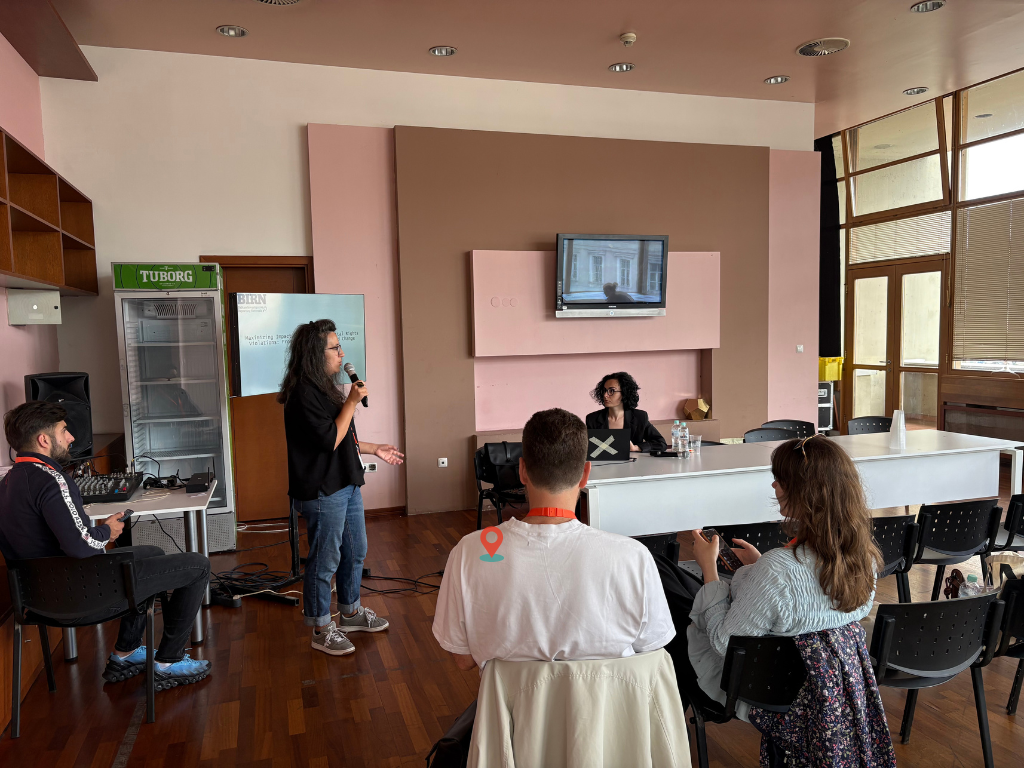
The session’s participants highlighted concerns about online disinformation, surveillance and coordinated attacks targeting journalists, activists and civic actors across the Western Balkans.
The panel dicussion Crowdsourced abuse: Technology-Facilitated Gender-Based Violence, moderated by Tijana Cvjetićanin from Zašto ne, brought together Nikolina Tomašević from Osnažene, Miljana Čabrilovski from the Roma Feminist Collective, Jelena Kalinić from Nauka govori and Azem Kurtić from BIRN Hub.
The speakers discussed how digital platforms have enabled new forms of harassment including coordinated online attacks, non-consensual sharing of intimate content, hate speech, doxing and targeted disinformation campaigns. They highlighted that such abuses often extend beyond the online sphere, resulting in psychological harm, self-censorship and reduced participation of women in public spaces.

”Many of the cases monitored by BIRN reveal common patterns across the Western Balkans,” Kurtić said. “Gender-based online violence, for example, manifests in similar ways throughout the region, but each country also has its own specific context. Nationalist rhetoric often intersects with these attacks, giving them a distinct local dimension while reflecting broader regional trends.”
The annual POINT Conference (Political Accountability and New Technologies) brings together civil society organisations, journalists, activists, researchers and technology experts to discuss democracy, human rights, digital governance and the impact of emerging technologies.