BIRN Supports 28 Media Outlets in Engagement Journalism

Journalists and editors from 28 media outlets in six Balkan countries are being given financial and editorial support to engage their local communities in the reporting process.

The Balkan Investigative Reporting Network, BIRN, launched a new round of support for media outlets across the Balkans in October 2022, continuing the regional Media for All project.

BIRN will provide editorial and mentoring support to journalists and editors from total of 28 media outlets from Albania, Bosnia and Herzegovina, Kosovo, Montenegro, North Macedonia and Serbia.

The group of 28 media outlets was previously supported in 2020 and 2021 within the same project through training, grants, technical support and mentorship to enable engagement with local communities and enable citizens to participate in the reporting process, by suggesting topics, providing testimonials, documents and evidence.

BIRN’s support will now equip local media to further develop their skills in engagement journalism and raise their editorial standards, with a particular focus on storytelling, data analysis, verification and fact-checking, contributing to the fight against misinformation and disinformation.

The media receiving the support will continue to use the Engaged Citizens Reporting tool, ECR, which was developed by BIRN during the previous phase of the Media for All project.

Media outlets will receive support until the end of February 2023. They will also be able to carry on using the ECR tool after the project is complete, to ensure sustainability of engagement journalism methodology in the region and enable media to better answer the information needs of local communities on a long-term basis.

The project aims to achieve a level of relationships and standards in which media outlets and journalists report together with citizens, and not only about them.

The project intends to build on the results from the previous phase but also to help prevent the spread of and the susceptibility to misinformation and disinformation. It will continue to work towards the creation of high-quality, accurate and relevant content created with the community by using the ECR tool and with support from BIRN’s editors and journalists.

Community-engaged reporting, in which ordinary people’s voices are heard and unresolved issues are tackled, proved to be a game-changer, as shown by numerous examples from the previous project phase.

Citizens’ engagement in the reporting process has put additional pressure on local authorities and decision-makers to act on issues of concern. It has helped media outlets to listen to voices from the community while bringing innovation to their investigative reporting and newsrooms.

Journalists and editors who have already used the ECR tool say that it has transformed the way the media outlets communicate with their audiences, who feel empowered by helping shape the content of their own media.

“It has direct impact on mobilising communities to solve a problem, because we provide data … that they can rely on, and continue to seek their rights,” Dorjana Daka, editor of Albanian news website Informim, told BIRN in August 2022.

Informim investigated stories about the Roma community, whose members often do not have access to the internet and lack trust in journalists, but managed to engage them through ECR and community events.

BIRN’s manager for the Media for All project, Marija Vasilevska, said that BIRN continues to support the media outlets in the creation of quality content “required by citizens and for citizens”.

“This way we are bringing back trust in the media, but also increasing the audience of local media outlets. Moreover, we are giving voice to the voiceless, such as minorities and vulnerable groups of citizens to share information that can be placed on media outlets’ front pages, lobbying and advocating for real needs in society,” Vasilevska said.

This extension of the projects is built on successes from the previous phase. During the first phase of the project, 51 media outlets were supported, directly engaging more than 39,000 citizens in six countries through more than 300 different callouts for engagement, which resulted in more than 700 journalistic products in various formats, including articles, video, podcasts and multimedia content.

The Media for All project is being implemented in six countries in the region: Albania, Bosnia and Herzegovina, Kosovo, North Macedonia, Montenegro and Serbia. The project is funded by the UK Government and implemented by a consortium led by the British Council together with BIRN, the Thomson Foundation and Intrac.


BIRN’s Museum Reporting House Presented at International Journalism Week in Greece

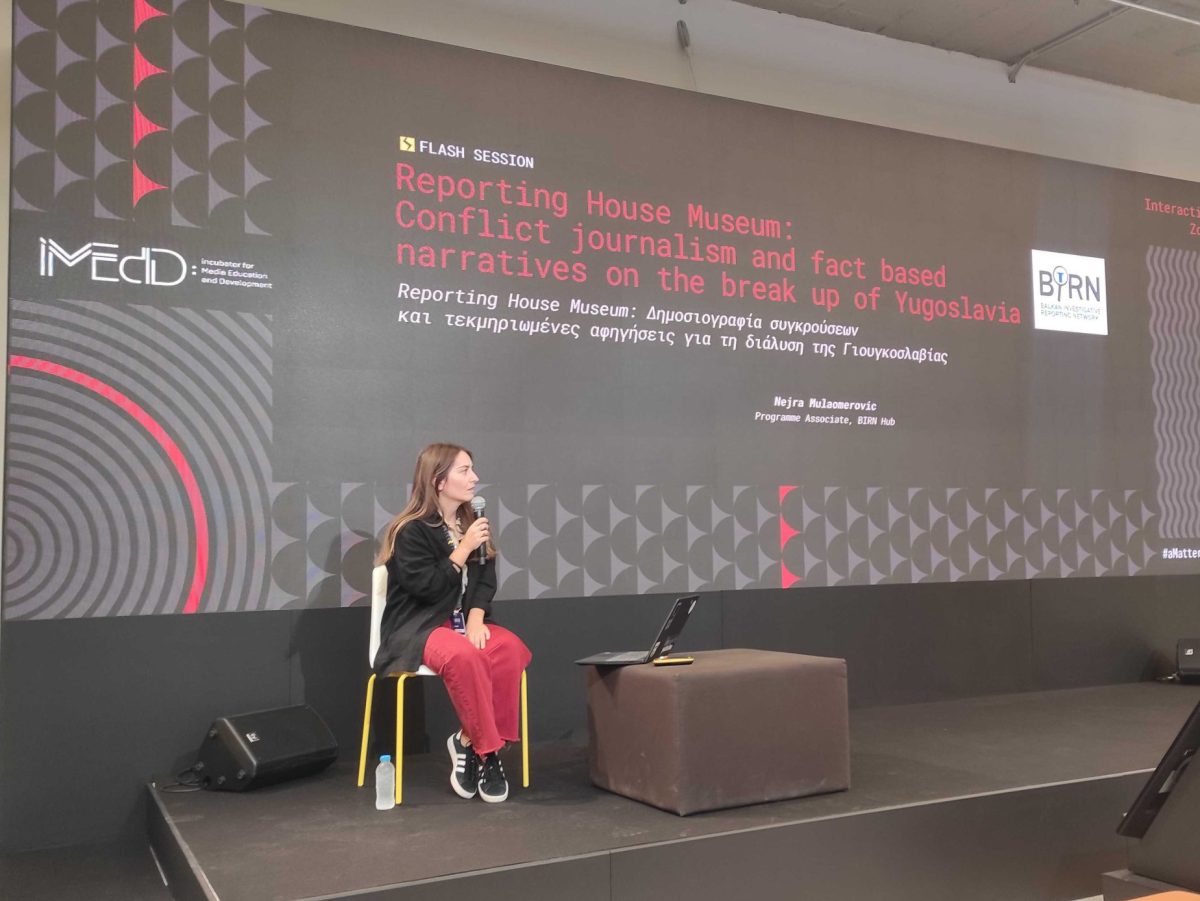
Nejra Mulaomerović, Programme Associate at BIRN’s Balkan Transitional Justice Programme, was invited to IMEDD’s International Journalism Week in Athens to speak about BIRN’s new museum.

Nejra Mulaomerović, Programme Associate at BIRN’s Balkan Transitional Justice Programme, presented BIRN’s new museum, Reporting House, dedicated to media workers who covered the war in Former Yugoslavia at Incubator for Media Education and Development – IMEDD’s International Journalism Week in Athens.

IMEDD, a Greek non-profit organization with a mission to support transparency and independence in journalism and promote meritocracy and excellence in the field, organizes the International Journalistic Week in Athens, where international organizations, journalists, and the student community meet to exchange experiences, opinions and knowledge.

Mulaomerović spoke to an international audience about BIRN’s initiative to create the first regional museum in the Balkans “built” by journalists and dedicated to them.

To ensure that transitional justice efforts are heard by a wider population, in 2021 BIRN started a bold initiative to create the first independent, non-profit regional museum in the Balkans that would bring the comprehensive story of the break-up of the former Yugoslavia and its aftermath to the attention of as many people as possible.

Guided by constant reevaluation and examination of the existing archives within BIRN and outside the network, a new direction emerged that unmasked a need for a distinct and reshaped approach to education and research within the transitional justice process, but also to role of media in it, in particular to disinformation and propaganda, but also the role that quality journalism plays.

“Journalists are engaged in creating the collection of the museum. We want to celebrate media workers who covered the war. A lot of people are not addressing the war trauma in our region. Reporting House would be a place where this topic will be discussed together with other issues of conflict journalism and transitional justice,” Mulaomerović said in her speech.

The museum will offer compelling, fact-based narratives on the break-up of Yugoslavia, the role of media propaganda in the war, war crimes in the former Yugoslavia, the life of journalists and media workers during the war and the overall challenges of war reporting in the 1990s in parallel with present conflict journalism challenges.

The goal of the museum will go beyond serving as a heritage venue of wartime history; despite the tragic events, BIRN wants to celebrate journalists, photographers and media workers who courageously reported the war and its aftermath, exposing atrocities and serious human rights abuses while maintaining the highest professional standards – despite the deadly risks they faced.


BIRN Kosovo Holds Workshop on Reintegrating Returnees from War Zones

BIRN Kosovo held a regional workshop on September 28 in the Prizren area on reinforcing the role of Centres for Social Welfare, Municipal Directorates of Education, of Emergency and Security, of Health and of Mental Health – and other relevant institutions – in strengthening the process of reintegration and resocialization of returnees from Middle Eastern conflict zones.

The workshop was delivered by Kreshnik Gashi, editor-in-chief at KALLXO.com and focused on the state’s vision for preventing radicalism and the violent extremism that leads to terrorism, as well as reflecting this vision to the public.

Twelve representatives from the aforementioned institutions participated in the workshop, five of whom were women.

This workshop was the fourth held by BIRN Kosovo as part of the “Resilient Community Program”, which is funded by the Global Community Engagement and Resilience Fund, GCERF.


BIRN BiH Journalist Shortlisted for Thomson Foundation Award

An investigation into the US far-rightist Robert Rundo and his organization by Nermina Kuloglija-Zolj of BIRN BiH has been shortlisted for the Thomson Foundation’s Young Journalist Award.

By Enes Hodzic

An investigative piece into US far-rightist Thomas Rundo’s influence in Serbia and Bosnia and Herzegovina, and his activities in those two countries, by Nermina Kuloglija-Zolj of BIRN BiH, has been shortlisted for the Thomson Foundation’s Young Journalist Award – dedicated to finding talented and ambitious journalists from all over the world. It is competing with 11 other stories.

BIRN BiH’s investigation into Rundo, who is considered the founder of the Rise Above Movement, R.A.M., in the United States, which says it is fighting a modern world corrupted by “the destructive cultural influences” of liberals, Jews, Muslims and non-white immigrants, shows that after having been accused of charges in the US, he headed towards Europe.

Although he has concealed his places of residence, Kuloglija-Zolj reveals that, over the past two years, he has appeared at numerous events in Serbia and participated in activities of various organizations opposing migrants, reiterating their anti-Roma and anti-Semitic stands and expressing disagreement with Serbia’s entry in the European Union and NATO.

It was determined also that he has spent a certain time in the eastern Serb-run part of Bosnia and Herzegovina.

At the same time, authorities in Serbia and Bosnia have not divulged information on when and how often he has crossed the borders between the two countries – one which he was officially expelled from, and the other from which, he said himself, he was banned and whose police were reportedly looking for him.

The aim of the Thomson Foundation’s Award for Young Journalists, which is presented in partnership with the UK Foreign Press Association, is to spotlight young journalists and their work and enable their voice to be heard and for them to feel the power of journalism to create significant changes. The award is open to journalists aged 30 or under, only from countries with a Gross National Income per capita of less than US$ 20,000.

After the list was announced, Kuloglija-Zolj said it was an honour to be placed among the 12 shortlisted young journalists who have worked over the past year on investigative pieces exposing inconsistencies affecting the development of their societies.

“The story about Robert Rundo, for which I was nominated, was a new experience in comparison to previous investigations,” she said, “due to the outspread of activities of the group with which he associated and, on the other hand, due to the closed nature of all those groups and the refusal of their leaders to be interviewed,” Kuloglija-Zolj said.

Now in its 10th year, the Award received a remarkable number of entries from all over the world. Besides the BIRN BiH journalist’s piece on Rundo, other nominees are from Yemen, Guatemala, Ukraine, India, Pakistan, Nigeria and Malaysia.

Following the announcement of the short-listed entries, independent judges at the UK Foreign Press Association will select three finalists whose names will be revealed in October. They will be vying for the award itself, to be presented on November 28 at a gala dinner in London.

In addition to receiving the award, the three finalists and three best shortlisted journalists will have a chance to be mentored by six established journalists and former students of the Thomson Foundation.


BIRN Albania Holds Training on Data Journalism for Young Journalists

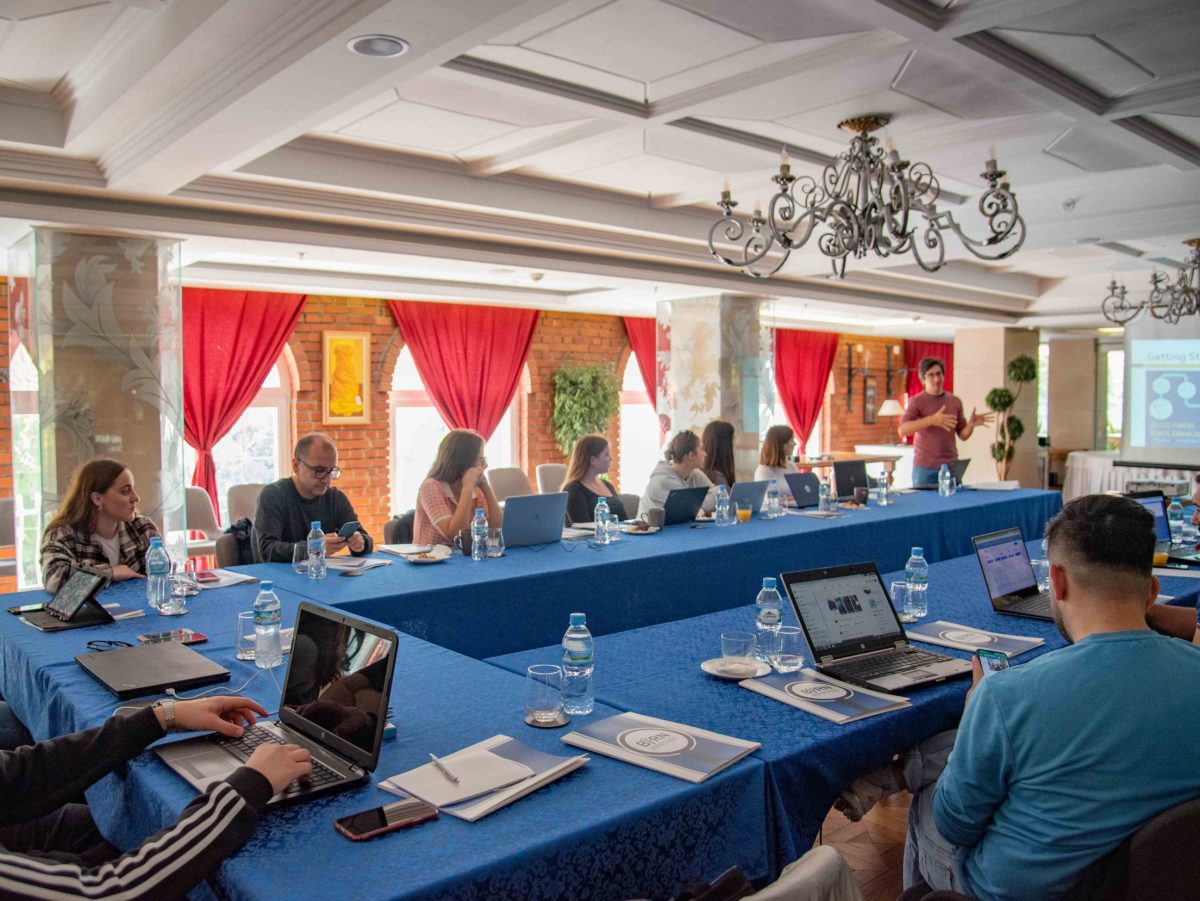
The Balkan Investigative Reporting Network in Albania, BIRN Albania, on September 27-28 held a two-day training course on data-based journalism techniques and visualization for young journalists, strengthening their capacities in this field.

Sixteen young journalists and journalism students from the 12 regions of Albania took part in the BIRN training session in Tirana.

Training was offered by editor Lawrence Marzouk and investigative journalist Crina Boros, in cooperation with BIRN Albania staff. Marzouk and Boros are the two main authors of the manual “Getting Started in Data Journalism”.

Besides increasing the knowledge of the young journalists in data collection and how to use it in journalism, the course enhanced their skills in mapping, analyzing and visualizing their data, using tools and techniques.

The training was part of the project “Using Big Data and Multimedia to Boost Quality and Independent Journalism in Albania”, which is supported by the European Union and Swedish government and implemented by BIRN Albania.

The project aims to create an enabling environment for Albanian journalists to produce independent content through training, mentoring, technical and financial support, and close cooperation with civil society, so improving freedom of expression and strengthening media pluralism in Albania.


BIRN Kosovo Holds Training on Reporting Labour Rights

On September 27, BIRN Kosovo held a training module for journalists on reporting labour rights. The training brought together 20 journalists from different communities who learned more about reporting on injuries at work, workplace safety, mistreatment and breaches of employees’ rights, lack of employment contracts, annual leave and maternity leave, among others.

Training was delivered by BIRN editors Kreshnik Gashi and Visar Prebreza, who have extensive experience in investigating, reporting, training and advocating these issues.

Guest speakers included Hekuran Nikçi, Chief Inspector of the Labour Inspectorate and Agim Millaku, Deputy Chief Inspector of Safety at Work.

The Labour Inspectorate said it would increase the number of inspectors to up to 100 by the end of this year. This year alone, nine workers died at their workplaces. It noted healthy cooperation between the Kosovo Labour Inspectorate and international labour organizations.

Labour Inspectorate Chief Nikci added that there is still no database recording workers working without contracts, or if their overall rights are being violated.

Kreshnik Gashi, editor-in-chief of the anti-corruption platform Kallxo.com, spoke about the use of whistleblowers and about building cooperation with institutions that deal with workers’ rights. He stated that some 50,000 workers in Kosovo have no work contracts and that Kallxo.com has received more than 500 reports from workers claiming their rights have been violated.

Visar Prebreza, Managing Editor at BIRN Kosovo, spoke about the topics that journalists can cover regarding labour rights.

Of the 20 journalists participating, from different media, 13 were women and four from minority communities. All participants will be asked to send story pitches to BIRN. Ten will be selected to win a bursary of 500 euros to write stories related to such important topics.

BIRN Kosovo’s journalists and editors will provide editorial support to the winning journalists in the process of identifying their topic of interest, the drafting of their editorial work and the final publication of their media products. These will be published on BIRN’s flagship anti-disinformation platform, Kallxo.com., in a TV/online format.

The bursary and the one-day training module are organized in the framework of the EU-funded project, “Protecting and promoting labour rights of vulnerable groups in the labour market”, which is implemented by ATRC and BIRN Kosovo.

The project aims to improve the working conditions of vulnerable categories of employees, notably within the private sector, including their workplace health and safety, through the promotion of social dialogue between workers and duty bearers.


Tirana Internet Freedom Meet Hosts Journalists and Activists From Region

BIRN Hub held a working conference in Tirana on September 24-28 for activists and journalists from Albania, Bosnia and Herzegovina, Kosovo, North Macedonia, Montenegro and Serbia focusing on digital rights challenges.

The event, designed to both inspire and raise the capacities of participants in current digital rights challenges and kick-start new partnerships brought together over 30 participants. Sessions focused on three major pillars – experiences of vulnerable communities in the digital landscape; capacity building on current topics; and team-work and joint activity planning to counter the growing abuse of new technologies and improve the regional tech eco-system.

The first session, a panel discussion entitled “Black Mirror: Who are the people (ab) using the Internet to violate human rights?” brought together regional Digital Rights Monitors working on documenting digital rights violations on the BIRD Monitoring Database in an attempt to “reverse-engineer” the process of committing digital rights violations and provide a profile of the perpetrators.

This was followed by another panel, “Making it real: How online violence against LGBT groups leads to offline Violence”, focusing on human rights violations against the LGBT community taking place online, and their implications and consequences in the real world, especially having in mind the latest violence seen during Belgrade EuroPride. The speakers were Ana Petrović (Da se Zna, Serbia), Elena Gagovska (independent journalist, North Macedonia), Xheni Karaj (Aleanca LGBT, Albania) and Branko Ćulibrk (KVART, Bosnia and Herzegovina). Both panels were moderated by Matteo Mastracci, Digital Rights Researcher at BIRN Hub.

On day two, Gilbert Beyamba from Pollicy (Uganda) presented the Feminist Principles of the Internet and a Ugandan perspective on fighting for women’s rights. The day ended with a remote knowledge-transfer session held by Carlos Antonio Guerra Merlo (Internews) focused on data protection.

The third day kicked off with Mila Bajić, from SHARE Foundation, presenting their Cybersecurity Toolkit. It continued with a panel discussion about the regional research of corporate accountability of telecoms, carried out in Albania, Bosnia and Herzegovina, North Macedonia, Kosovo and Serbia using the methodology developed by Ranking Digital Rights. The session hosted the people conducting the research: Gjergj Erebara (Albania), Matteo Mastracci (Bosnia and Herzegovina), Bojan Stojkovski (North Macedonia), Xhorxhina Bami (Kosovo) and Tijana Uzelac (Serbia) and was moderated by Besar Likmeta from BIRN Albania. Leandro Ucciferi, Global Partnerships Manager at Ranking Digital Right, provided the introduction to the session.

Day 4 of the Tirana Internet Freedom Meet was more topic-focused and centred around issues of privacy. Lucie Audibert, from Privacy International, provided insight into the work and experiences from PI regarding this issue. After the session, the participants visited the infamous House of Leaves, once the headquarters of the Gestapo and later of the Sigurimi, the Communist-era Albanian secret police, and now a museum. The last session of the day was focused on Artificial Intelligence and on cases of its misuse in Latin America. This was held by Michel Souza from Derechos Digitales.

The final day of Tirana Internet Freedom Meet was focused on the activities of the South-East Europe Digital Rights Network, a regional coalition of CSOs working on improving the digital rights landscape.

The Tirana Internet Freedom Meet is a part the Greater Internet Freedom (GIF) project, funded by USAID and implemented by Internews and its regional and local partners.


BIRN Albania Opens Call for Investigations on Healthcare

BIRN Albania launched a call for investigative stories on September 26, offering grants for three journalists to produce articles on the private and public health systems in Albania.

BIRN is offering grants for three journalists to cover stories on the healthcare system, as well as mentoring by experienced editors.

The call is part of the project ‘Promoting Accountability through Investigative Journalism’, supported by the National Endowment for Democracy, NED.

This project aims to build bridges between journalists, experts and civil society activists so they can strengthen the fight against corruption and impunity through investigative journalism.

Three journalists will be awarded grants to cover their expenses while conducting investigations and writing stories on topics related to the private and public health systems in Albania.

The journalists will have around three months to dig deeper and research their ideas, and will also have the opportunity to work with experienced editors as mentors to guide them through the process of writing in accordance with BIRN standards.

The call only applies to journalists from Albania and closes on October 16.

Click here for more information (in Albanian) about the application procedure.

Click here to download the application form (in Albanian).


BIRN, n-ost, Hold Workshop in Ohrid on Environmental and Climate Reporting

BIRN Hub and partner organization n-ost held a workshop from September 20-23 in Ohrid, North Macedonia, on cross-border environmental and climate reporting for 18 journalists from Albania, Bosnia and Herzegovina, Kosovo, North Macedonia, Montenegro and Serbia.

Over three days, participants learned from trainers Besar Likmeta and Dragan Gmizic how to form teams and investigate environmental issues in their countries.

The trainers shared what it takes to establish a research team, publish and follow up on your investigation.

“When you investigate and publish about sensitive issues, for example on some public officials breaking the law, it’s better to have a network of journalists standing behind you,” said Likmeta, on the importance of cross-border journalism.

On the second day of the workshop, the participants learned more about climate journalism from guest lecturer Angelina Davydova. “Climate journalism is complicated, but allows for international cooperation, cross-border reporting and many training opportunities,” Davydova said. Participants then discussed how to address climate change in stories they’re interested in.

Finally, participants discussed local environmental issues related to nearby Lake Ohrid with Vladimir Trajanovski, from SOS Ohrid, a citizens’ initiative, which is active in protecting the area and its environment.

“Investigative journalists in North Macedonia helped us a lot by writing in their way about topics we pointed out to them, and had a crucial role in exposing problems,” Trajanovski said.

At the end of the workshop, participants formed cross-border research teams and will work on stories in the next two months until they gather again.

This was a first workshop organized as part of the project entitled Going Environmental, which is financed by the German Ministry of Economic Cooperation and Development.


Open Call: BIRN is Seeking Data/Business Journalists

As part of its new project focusing on Foreign Direct Investment, FDI, in the Balkans, South Caucasus and Central Asia, BIRN is looking for journalists with strong competence in economic issues and experience in data editing and data journalism.

Reporters with experience in data and business journalism from Bosnia and Herzegovina, Montenegro, North Macedonia and Serbia are strongly encouraged to submit their applications no later than October 14, 2022.

Selected candidates will be working on “Spheres of Influence Uncovered”, a joint project by the Berlin-based media NGO n-ost, BIRN, the cross-Caucasus media outlet JAMnews and an online media outlet from Uzbekistan, Anhor.uz. Its primary focus is mapping and exploring FDI in the Balkans and Central Asia.

BIRN is looking both for freelancers and permanent employees of national and local media and private and state-owned outlets/public broadcasters. Experience in different media formats is preferable, and experience in business and data journalism is a must.

As the project language is English, aspiring candidates must have good oral and written proficiency in English.

During the timeline of the project, from 2022 to 2025, several training sessions and other networking activities will take place in the Balkans and Central Asia, which all participating journalists will have to attend. The first, a kick-off meeting in Tbilisi, Georgia, will take place in mid-November 2022, most likely on November 11-13. Details will follow in the next few weeks.

Journalists will be researching FDI in their respective countries in a specified timeframe. Most FDI come from three key players – the EU, China and Russia, competing for influence in both regions. Information that journalists collect will form the basis for an online interactive map and a database, which is intended to shed more light on key investment projects and inform the general public in the project countries, but also beyond, about the consequences, criticisms and challenges these investments have provoked.

Selected participants also will attend a series of offline training sessions to boost their data, investigative and journalism skills: to learn how to properly fact-check a story; how to protect themselves in a digital surrounding; and learn more about specific directives and laws that China and Russia often violate. A special focus of the project is fostering cross-border cooperation and transnational and transregional networking of data and investigative journalists.

Last but not least, participants will produce a series of investigations and long-read articles, using the database and interactive map as a starting point and source of information.

Selected candidates will benefit from:

  • taking part in a long-lasting journalistic project with enough time and resources to work on complex topics
  • boosting their cross-border skills and working closely with colleagues from different regions
  • the opportunity to expand and deepen their knowledge of their economic and (geo)political context and the consequences of investment and credit projects with foreign partner countries
  • the opportunity to improve their journalistic skills with a view to investigative research, data journalism, and processing complex issues and large amounts of data
  • gaining experience in building and using an international database on international economic cooperation and investment projects
  • financial support for innovative and complex publication projects
  • integration into an international journalistic network whose members benefit from one another through shared journalistic interests and mutually complementary skills

The project will consist of a number of online and offline activities during the next three-and-a-half years, which all selected participants will have to attend, which include traveling. Below is a preliminary list that will be defined further in the next weeks and months:

  • A kick-off meeting in Tbilisi in mid-November 2022
  • December 2022: one of the two training sessions, each lasting two-and-a-half days, in Belgrade (Serbo-Croatian/English) and in Tashkent (Russian)
  • Spring 2023: Joint training for three-and-a-half days (English) in Tbilisi, on data collection
  • Autumn 2023: Joint training for three-and-a-half days (English) in Podgorica, Montenegro, for the preparation and presentation of data – storytelling, infographics, video editing, social media production.
  • Spring 2024: (a) a two-day in-depth training course in Sarajevo, Bosnia, on how to use the database for the project participants; (b) a two-and-a-half-day work meeting for the participants with an extended group of experts and (business) journalists (25 project participants + 25 others)
  • Work on the database
  • Production of country-based and cross-border long reads and investigative reports

The project, which started on September 15 and lasts until December 31, 2025, includes the following countries: Serbia, Montenegro, North Macedonia, Bosnia and Herzegovina, Georgia, Tajikistan, and Uzbekistan.

Other partners on the project include the lead partner n-ost, from Germany, Anhor.uz, from Uzbekistan and JAMnews (headquartered in Tbilisi).

Click here to apply.