BIRN Kosovo Holds Workshop on Reintegrating Returnees from War Zones

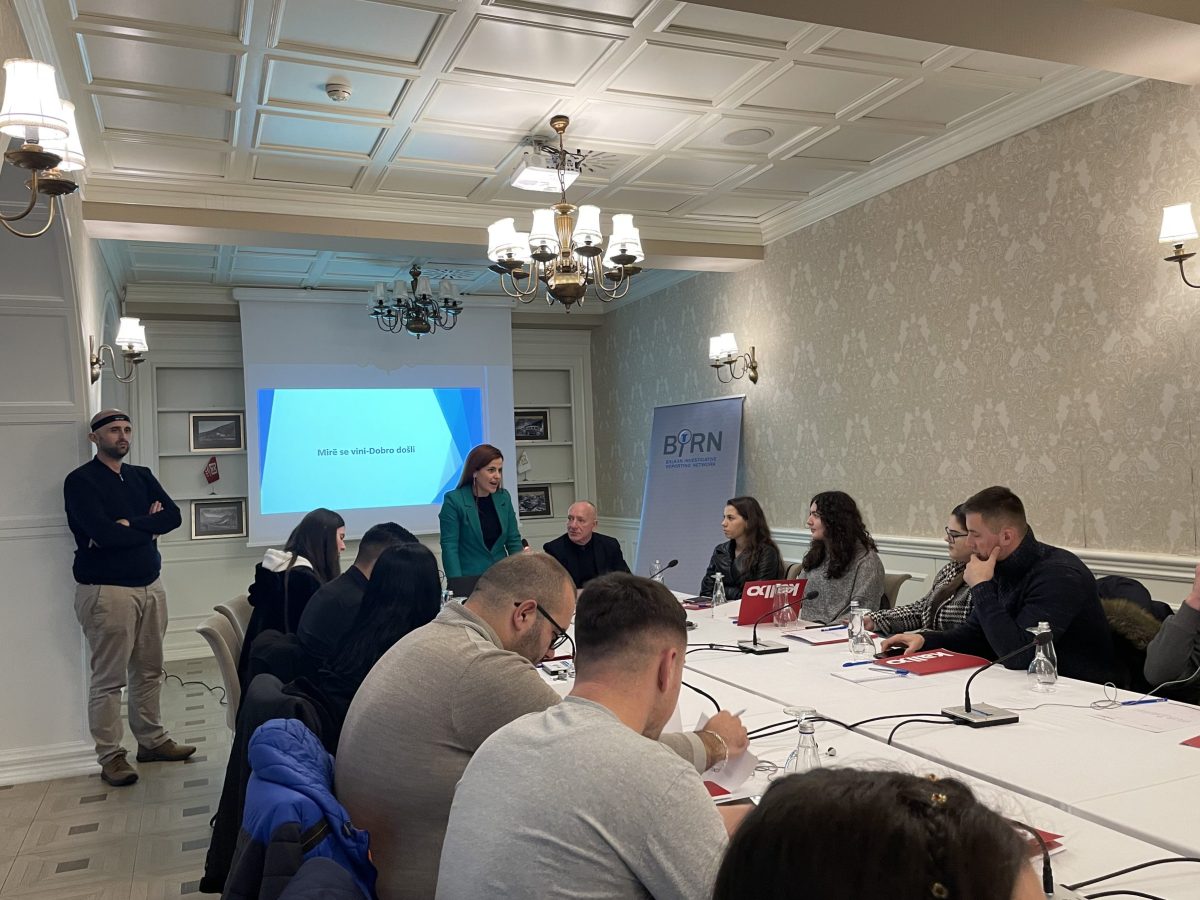
BIRN Kosovo held a regional workshop on November 25 in the Gjakova area on reinforcing the role of Centres for Social Welfare, Municipal Directorates of Education, of Emergency and Security, of Health and of Mental Health – and other relevant institutions – in strengthening the reintegration and resocialization of returnees from Middle Eastern conflict zones.

The workshop, delivered by Labinot Leposhtica, legal officer at KALLXO.com, focused on the state’s vision for preventing radicalism and the violent extremism that leads to terrorism, as well as reflecting this vision to the public.

Eleven representatives from the aforementioned institutions participated in the workshop, three of whom were women.

This workshop was the fifth held by BIRN Kosovo as part of the “Resilient Community Program”, which is funded by the Global Community Engagement and Resilience Fund, GCERF.


Meet the People Behind BIRN: Fjori Sinoruka

Each month, BIRN introduces you to a different member of its team. For November, meet Fjori Sinoruka, Balkan Insight’s Albanian correspondent.

Fjori Sinoruka, 29, has been working for BIRN’s flagship Balkan Insight for the last two years as our correspondent from Albania.

Based in Tirana, she studied journalism and always wanted to be in the media. For her, journalism is connected with two important words: democracy and responsibility.

Her favourite topics to report on are public security, human rights, corruption, cybersecurity and cyber-defence. In the last few months, she has been closely following the big cyber-attack on the Albanian government and the data leaks that have followed.

Let’s meet her:


  1. Why did you decide to become a journalist? 

I’ve wanted to be a journalist since I was a kid, without really knowing exactly what it was. Growing up, I never gave up on this idea. My first years after graduation were very hard because I wasn’t really finding myself and wasn’t ready to compromise to fit in. Back then, everyone was working on the digital media and all that was required was copy and paste. So, I and a colleague created a small media NGO and started reporting about human rights and environment.

  1. Do you have a favourite journalism quote?

I do not have a concrete quote on my mind, but when I think about journalism, I connect it with responsibility and democracy. When I say “responsibility” I mean that each journalist should feel that when they are doing their job, especially in times when so much fake news and disinformation is spread. And democracy, because there is no democracy without free media.

  1. What do you like most in your job, and what is the most challenging thing?

What I most like about my job is that it doesn’t feel like a job. It doesn’t feel like I have to do it. I also like talking with people, hearing their stories. While working on certain articles for Balkan Transitional Justice, with victims of communism, it was important to educate myself not to re-traumatize people while asking questions or asking them to tell their stories and experiences under communism. It’s very rewarding when you see that you have succeeded in building a trusting relationship with people.

There is always something new to learn.

A thing that I would consider challenging is the media environment in the country. It’s frustrating when you cannot get answers or access certain data that you might need it for a story. Still, it is important not to give up.

  1. What kind of stories do you prefer to work on and why? Which is your favourite story you have written for Balkan Insight so far?

It is very hard to single out one of them because there are several topics I like to work on: public security, human rights, corruption and lately cyber-security and cyber-defence. I also like stories I do about communism, It is very important to keep talking about its consequences, especially in the Albanian context, where there is no closure and the past remains very present. As a correspondent I usually report about every important topic, meaning you have to be at the same time everywhere – and I love it.

  1. You have been following the big cyber-attack on the Albanian government and the data leaks that have followed. BIRN disclosed that the authorities banned the media from reporting on this. Can you tell us more about this story and its importance? 

I think that how this issue is being dealt with in the country tells a lot about it. You have a Prosecution order that bans the media from reporting about the leaks while on the other hand there are other institutions and Prime Minister himself saying that no important data has been compromised or damaged. Why, then, did the Prosecution ban the media from reporting, if no important or sensitive or confidential data is out there?!

On the other hand, we have tried to get answers from institutions for months and haven’t managed to even get a confirmation or a denial about the leaked data.

Nevertheless, we have continued reporting because I believe that it is an issue of public interest. It is a case where the public interest is more important than any banning order.

  1. What is your advice to aspiring journalists who want to work as correspondents in our region? 

Be committed to professional improvement, read a lot and continue reporting, no matter what.


UNICEF Gives BIRN BiH Journalists Special Recognition for Contribution to Children’s Rights

Two journalists of the Balkan Investigative Reporting Network of Bosnia and Herzegovina, BIRN BiH, Emina Dizdarevic and Jasmin Begic, received special recognition for media contribution to the promotion and protection of children’s rights in Bosnia and Herzegovina in 2022.

Dizdarevic received special recognition for her analysis, Experts Warn that New History Textbook in Tuzla Deepens Divisions”. In it, she explained that, as of April, elementary school pupils in the Tuzla Canton have learned about the 1992-5 war in more detail for the first time through a new appendix to the history textbook for grade nine, which experts call one-sided.

They say it contains a publication by a convicted war criminal as a reference, and fails to respect the guidelines for writing textbooks and mention the suffering of all peoples, thus additionally deepening divisions.

Dizdarevic, who has been a journalist with BIRN for nearly ten years, says the recognition of her contribution to child’s rights in 2022 is very meaningful; the UNICEF award speaks about the educational system in her country and points to the problems of unadjusted school curricula.

“I’m glad if I have contributed, at least at the micro level, to changing the situation in the Bosnian educational system. I believe children should learn and study history and the 1992-95 war in Bosnia and Herzegovina precisely from judicially determined facts,” she said. Dizdarevic previously also won the Srdjan Aleksic and other awards.

Begic joined BIRN’s team in July 2021. He received UNICEF’s special recognition for an analysis, “Central Bosnia Canton Does not Respect Verdict on Abolishing Segregation in Schools”, about the failure to respect court verdicts due to which pupils throughout Bosnia spent yet another school year in a segregated system.

“I’m grateful for the recognition which is, at the same time, an incentive and obligation for even more devoted and professional work in the future,” he said.

UNICEF’s contest for best media contribution to the promotion and protection of child’s rights in Bosnia was open for all journalists who published articles on this topic in Bosnian media this year.

An award for overall contribution to promotion and protection of children’s rights during 2022 through journalistic pieces, articles on portals, blogs, TV or radio footage, vlogs or documentary, was given to Istinomjer journalist Minel Abaz again this year.

Jury member Boro Kontic said that 23 pieces on various topics, including emotional difficulties, influencers, religious teaching, child migrants, talented children, violence in schools, segregation in schools and curricula content, were submitted for the competition; all of them were of good quality.

UNICEF’s representative in Bosnia and Herzegovina, Rownak Khan, gave credit to those media that cover children’s rights through their channels, adding that the award was a recognition of journalists who cover these important topics in a courageous manner.

She said the public can be informed about children’s rights through the media more than in any other way, adding that on International Children’s Day, every November 20, it is important to recall the promise states made by adopting the Convention on the Rights of the Child more than 30 years ago, Fokus reported.

In 2020, BIRN BiH journalist Azra Husaric-Omerovic received UNICEF’s recognition for contribution to promotion and protection of child’s rights in Bosnia and Herzegovina in the “internet piece” category for her story on the challenges children with learning disabilities and their parents faced while attending online classes during the pandemic.


BIRN, n-ost, Hold Workshop in Kolasin on Data Visualization and Environmental and Climate Reporting

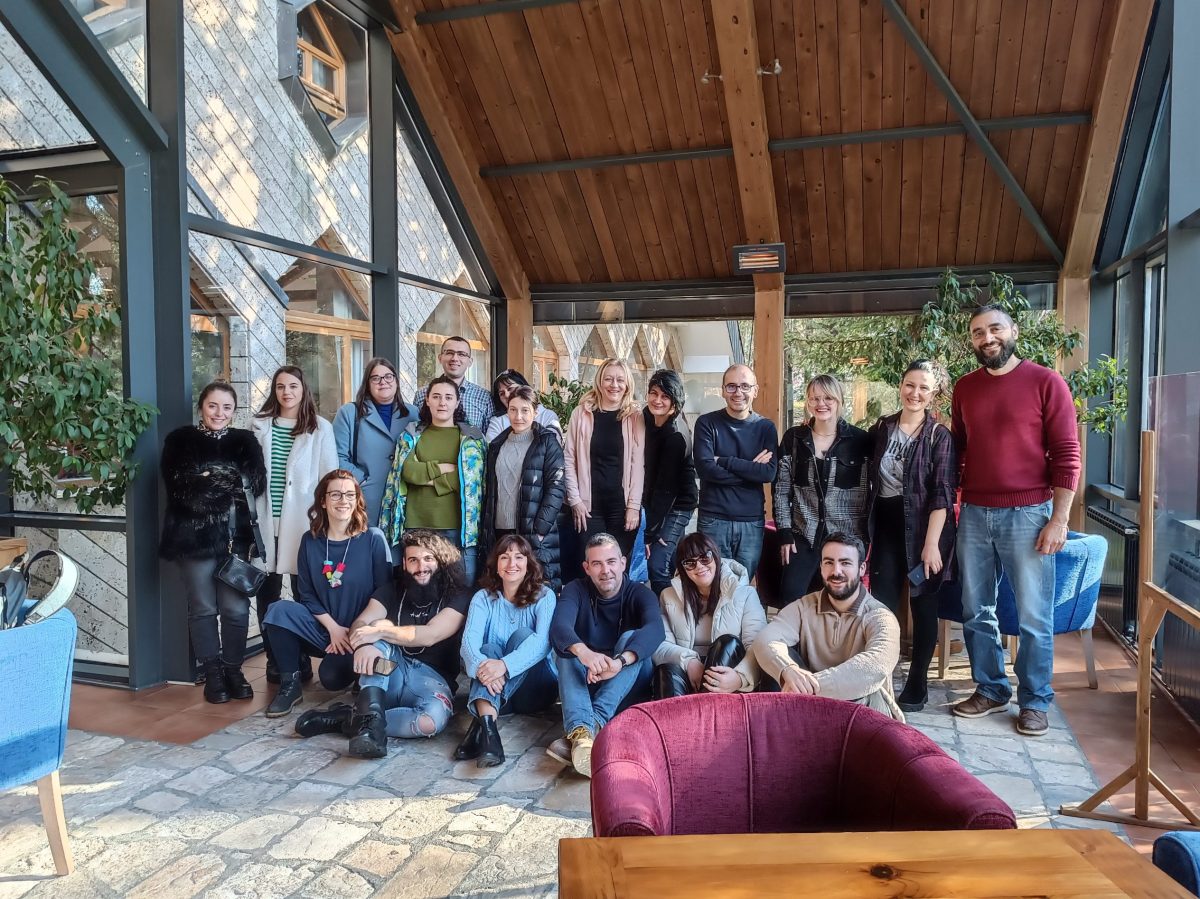
BIRN Hub and partner organization n-ost held a workshop from November 21-24 in Kolasin, Montenegro, on data visualization and cross-border environmental and climate reporting for 18 journalists from Albania, Bosnia and Herzegovina, Kosovo, North Macedonia, Montenegro and Serbia.

After forming cross-border teams at the workshop in Ohrid in September, participating journalists reunited to continue their investigations related to topics such as river pollution, waste management and consequences of climate change in the region.

During the first day, they learned about data visualization and data storytelling from Uros Krcadinac, digital artist, technologist, writer, and educator.

Uros explained how to present visual data and information clearly and in an emotionally engaging way, with a special focus on ecological and climate data. He also introduced them to tools they can use while working on their own datasets, such as Raw Graphs, Pictochart, Canva, Google Spreadsheets, Tableau Public, etc.

“It’s important to have openness towards new tools. Allow yourself to play with them, with any data that you have, because it will make your stories more compelling,” Krcadinac said.

Participants also had the chance to discuss the local environmental issues related to the devastation of Tara River with highway construction with Lazar Grdinic, from the NGO MANS.

“We asked the environmental inspection many times to carry out regular on-site visits to separate locations. I was there on-site with inspectors, but even during those visits they didn’t show any willingness to stop the devastation of this river,” Grdinic said.

On the second day, participants refreshed their knowledge on story structure and storytelling, while continuing group work on their cross-border stories with the assistance of their mentors, Besar Likmeta and Dragan Gmizic. By the end of the workshop, they had drafted the structure of their stories, which will be finalized and published in the following months.

This was the second workshop organized as part of the project “Going Environmental”, which is financed by the German Ministry of Economic Cooperation and Development.


BIRN Trains Journalists from 46 Outlets in Fact-Checking

Journalists from 46 media outlets in the Balkans were given online training in fact-checking skills intended to combat misinformation and boost independent reporting.

The Balkan Investigative Reporting Network organised three online training sessions entitled ‘Fact-checking for the resilience of the independent media’ from November 7 to 22 as part of the Media for All project.

Journalists from 46 media outlets from Albania, Bosnia and Herzegovina, Kosovo, Montenegro, North Macedonia and Serbia learned about the differences between misinformation, disinformation and malicious information.

They also learned about specific tools that can be used for the checking and verification of sources and facts when producing media articles.

They had the opportunity to look into case studies and fact-checking examples used in producing content for BIRN’s news website Balkan Insight.

Ivana Jeremic, an experienced fact-checker and Balkan Insight editor, taught journalists the most important contemporary tools used for fact-checking and verification.

Jeremic guided participants in creating fact-checked investigations, news, and reports. The participants had a chance to discuss specific ideas for creating accurate content and got familiar with precise sources to use in their production.

“Fact-checking is the process of checking the accuracy of the information before publishing the story followed by checking the statements of certain actor,” said Jeremic.

“Fact-checking is part of journalists’ work. You as a journalist can be a fact-checker and a fact-checker can be a journalist. But the process of fact-checking is constantly trying to question the information that you have received or that you have heard and trying to find relevant sources either to confirm or debunk that information,” she added.

The skills learnt during the training session are intended to be used in the journalists’ daily work and shared with their colleagues in their newsrooms as part of the fight against fake news and disinformation.

The Media for All project is being implemented in six countries in the region: Albania, Bosnia and Herzegovina, Kosovo, Montenegro, North Macedonia and Serbia. BIRN is working in partnership with the British Council, Thompson Foundation and Intrac on the project, which is funded by the UK government, with special attention to engaging the public in reporting and fighting fake news.

BIRN Kosovo Holds Training on Combating Gender-based Misinformation and Sexist Language in Media

On November 30, 2022, BIRN Kosovo organized a training workshop on combating gender-based misinformation and avoiding sexist language in media reporting.

The training brought together 23 participants, 12 of whom were women and 11 of whom were from minority communities, such as Serbian, Roma, Egyptian, and Bosnian.

The participants were from the University “Haxhi Zeka” Law Faculty, media, civil society organizations and media outlets, including: Gracanica Online, Radio Gjakova, Radio Goraždevac, Peja në Fokus online platform, Roma in Action, Mladi Volonteri, and NPU.

The training was delivered by BIRN editors Kreshnik Gashi and Visar Prebreza, who have extensive experience in carrying out investigations and reporting, as well as in delivering training activities for media members and other relevant stakeholders.

Participants learn about topics such as advanced international fact-checking standards, techniques for fact-checking in gender issues and reporting on gender discrimination through traditional and online media.

The training was organized as part of the “Addressing Misinformation Through Fact-Based Journalism” project, which is implemented by BIRN Kosovo and supported by UNMIK.

The aim of the project is to help combat the spread of fake news and disinformation in Kosovo by raising the public’s awareness of these phenomena, while promoting and supporting fact-checking journalism.


BIRN Kosovo Holds Training on Advanced Fact Checking Techniques

On November 25, 2022, BIRN Kosovo in cooperation with Gracanica Online held a training session on conducting research and investigations using advanced fact-checking techniques.

The training brought together 23 journalists, nine of whom were women, from different communities in Kosovo who represented: Ulpiana Press, Gracanica Online, Radio Television of Gracanica, Riznica, representatives of Civil Society organisations (The Ideas Partnership, Balkan Sunflowers Kosova, and CPT), and students from Graçanica, Prishtina and Mitrovica.

Participants learned more about the techniques of fact-checking standards and how to report based on them, what reporting discrimination is, and how to promote media literacy through traditional and online media.

The training was delivered by BIRN editors Kreshnik Gashi and Visar Prebreza, who have extensive experience in carrying out investigations and reporting, as well as in providing training for media and relevant stakeholders.

“As a long-experienced journalist, it is always a pleasure to learn more about treating discrimination as a topic in news and on providing fact-checked news and information,” stated one of the participants, Jelena Mirkovic, from Radio Television of Gracanica.

The training was organised as part of the “Addressing Misinformation Through Fact-Based Journalism” project, which is implemented by BIRN Kosovo and supported by UNMIK.

The aim of the project is to help combat the spread of fake news and disinformation in Kosovo by raising the public’s awareness of these phenomena, while promoting and supporting fact-checking journalism.


BIRN Conference Warns of Far-Right Groups’ Influence in Balkans

Far-right and extremist groups are a major threat in the Balkans as they have deep roots in society and exert a significant influence, a BIRN conference in Sarajevo concluded.

By Azem Kurtic

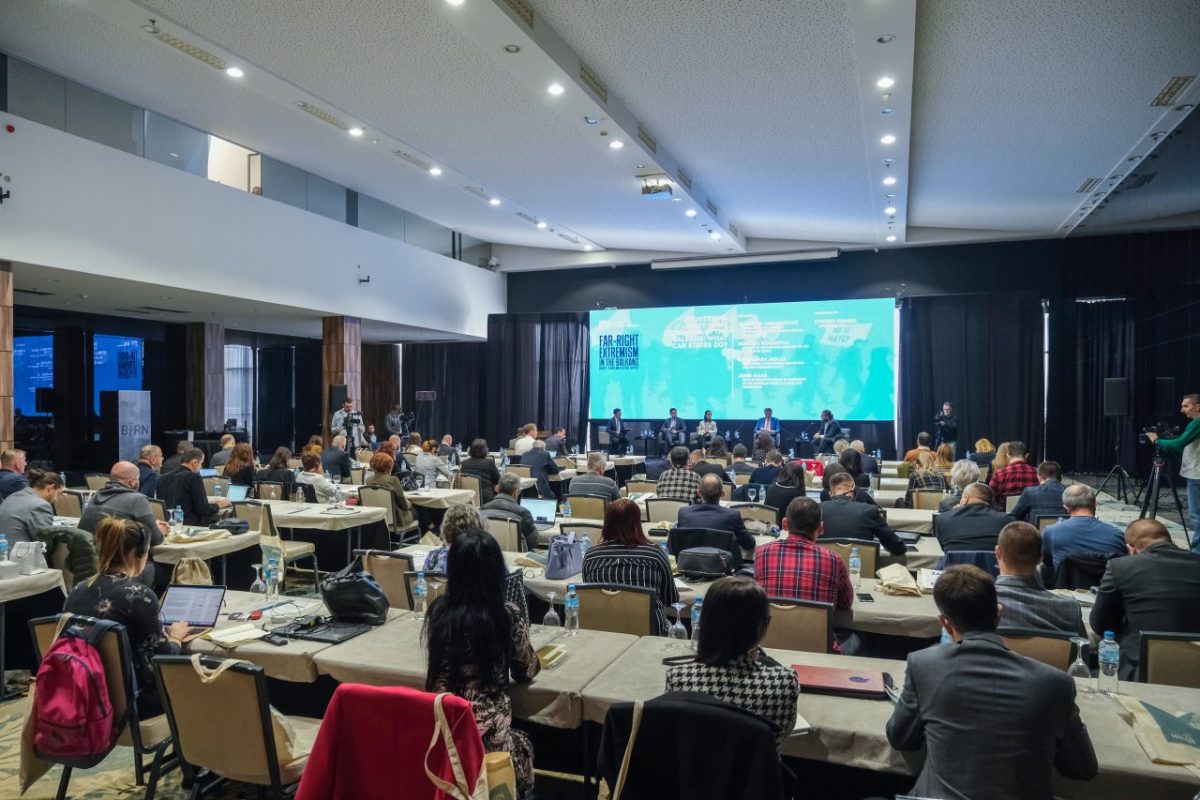
The influence of far-right and extremist groups on societies in the Balkans is much greater than immediately visible, a two-day conference in the Bosnian capital Sarajevo concluded on Thursday.

“Unfortunately, far-right movements have taken the government in some Balkan countries,” Semsudin Mehmedovic, a member of the House of Representatives of Bosnian state-level parliament, told the conference.

More than 80 journalists, activists, government officials and international and local experts attended the conference, ‘Far-Right Extremism in the Balkans: Groups, Trends and Political Support’, which aimed to discuss the influence that such groups exert.

During the conference, BIRN launched an interactive map giving detailed information about 71 far-right and extremist groups and organisations operating in six countries in the Western Balkans, created by researchers and journalists.

Their findings showed that these groups are often connected, and are active online and in the public arena. They communicate and organize nationally and internationally, and are increasing their presence in politics, not only in the Balkans, but also in European Union countries, it was also found.

“Even in the context of Europe, we have seen far-right parties increasing their presence in parliaments. Democratic values are a threat to their ideas,” said Barbara Molas, a researcher with the International Centre for Counter-Terrorism.

Many of the groups that are active in the Western Balkans are pro-Russian, which became increasingly noticeable after Russia’s invasion of Ukraine.

“During Russia’s attack on Ukraine, we discovered pro-Russian groups on Telegram whose content was copied into Serbian groups, spreading misinformation and photos that incite violence,” said Maja Zivanovic, head of Radio Free Europe’s bureau in the Serbian capital Belgrade.

Many panelists and participants warned that the struggle against far-right and extremist groups in the Balkans and the rest of the Europe is only just beginning.

The second day of the conference was dedicated to the topic of political support for the far right.

Marko Milosavljevic, programme coordinator at the Serbian branch of the Youth Initiative for Human Rights, noted the presence of extremist political party Dveri in the Serbian government.

“An example that I would like to present, which shows that there is extremism in the government and authorities of Serbia, is that at the suggestion of the extremist party Dveri, the part of biology textbooks that deals with gender and sex was redacted,” Milosavljevic said.

The interactive map and the conference were a part of a project entitled ‘The Future of Extremism in the Western Balkans’. During the course of the project, several studies and analysis pieces about far-right and extremist groups in the region have been published, as well a number of articles about terrorism trials in Western Balkan countries.

BIRN Launches Interactive Map of Far-Right and Extremist Groups

The Balkan Investigative Reporting Network has published an interactive map providing detailed information about scores of far-right and extremist organisations in six countries in the Balkans.

By Enes Hodzic

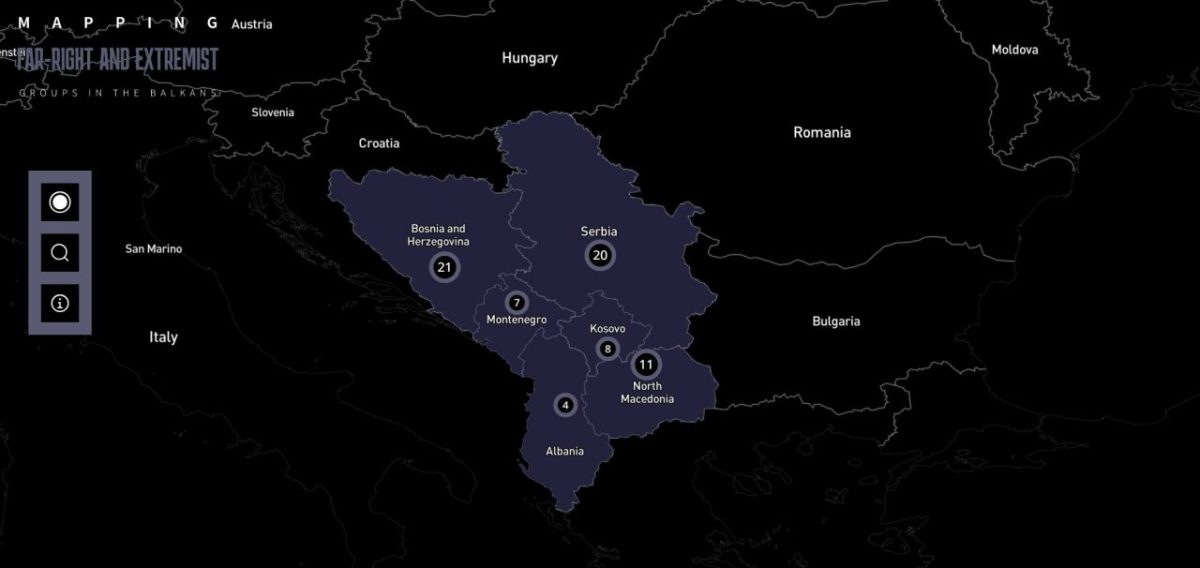
BIRN on Wednesday launched an interactive map giving detailed information about 71 far-right and extremist groups and organisations operating in six countries in the Western Balkans.

The map, a joint effort between BIRN and independent investigative journalists and researchers, was launched at a conference in Sarajevo entitled ‘Far-Right Extremism in the Balkans: Groups, Trends and Political Support’.

The map’s database documents both formal and informal extremist and far-right groups and organisations, including 21 in Bosnia and Herzegovina, 20 in Serbia, 11 in North Macedonia, eight in Kosovo, seven in Montenegro and four in Albania.

It includes details about their members, including names and aliases, as well as their official status and activities, sources of funding and affiliations with other organisations. It also includes details of court cases in which members of the organisations have appeared.

BIRN Bosnia and Herzegovina’s director Denis Dzidic said that the information presented in the interactive map provides the public with more information about far-right and extremist organisations and the potential threats that they pose.

“For the first time ever, we have a map that collects relevant information on far-right and extremist groups in the entire region,” said Dzidic.

“Their actions distort the process of building a stable and healthy society which we are fighting for every day. It is therefore important to us that this map be a source of information that will recognise all the threats that such organisations and groups may create,” he added.

Dzidic explained that Bosnia and Herzegovina has finally recognised the threat from far-right and extremist groups through its national Strategy for Prevention and Fight against Terrorism. This makes reporting on such organisations and groups’ activities of even more important, he said.

The map’s database took several months to collate – a process that was complicated by the fact that the majority of these organisations and groups are not registered and their activities can only be monitored online.

The map is currently available in English, but will soon be published in the local languages of the countries included. It will also be updated when new organisations and groups are established and when new far-right or extremist activists emerge.

“One of our permanent missions is to contribute to a freer and safer world. By creating a thoroughly checked and researched tool for fighting the constant threat from far-right and extremist groups, especially in the Balkans, we want to contribute to those efforts as much as possible,” Dzidic explained.

The interactive map was created as part of a project entitled ‘The Future of Extremism in the Western Balkans’, which is funded by the government of the Kingdom of the Netherlands. During the course of the project, several studies and analysis pieces about far-right and extremist groups in the region have been published, as well a number of articles about terrorism trials in Western Balkan countries.

BIRN Seeks IT Enthusiasts, Coders to Help Investigative Reporters

In a bid to help journalists improve their tech skills to work on investigative stories, BIRN is forming a network of IT experts willing to provide assistance to reporters across the South East and Central Europe

Many journalists across the SEE and CE are still struggling with emerging technologies that could help them dig deeper and tell their stories better.

Reporters and media workers are also vulnerable to digital threats, and need to be properly equipped with basic tips and tools on how to combat them.

Responding to these needs, the Balkan Investigative Reporting Network, BIRN, is calling on coders, programmers and other tech experts to become part of an informal network CODE4SEE (SEE is an acronym for the South-East Europe region).

The aim of the CODE4SEE network is to assist journalists with time and expertise. Engagement is on a voluntary basis, aiming to support stories that are in the public interest. CODE4SEE network members will to contribute pro bono, although in exceptional cases journalists might be asked to pay small fees.

BIRN is seeking to bring together IT experts from South-East and Central Europe, and students are also encouraged to join the network.

According to BIRN’s assessments, journalists are having specific issues with navigating online databases, scraping, exploiting open source programmes, big data analytics, data visualisation, finding and verifying data on social media and staying safe online.

BIRN aims to promote the CODE4SEE network on its various platforms, social media channels and mailing lists, and to encourage regional journalists – both freelancers and those working for media outlets or public broadcasters –  to reach out to its members whenever they need a hand with incorporating technical expertise into their journalistic work.

Network members will also be strongly encouraged to reach out to journalists and propose ideas or suggest a story/topic to be further explored.

Since its inception – in addition to its work in investigative journalism – BIRN has positioned itself as a leading regional organisation providing capacity-building support to journalists and editors in the Balkans and beyond.

BIRN provides training, editorial and mentoring support through various projects, including its flagship programmes, the Summer School of Investigative Reporting and the Balkan Fellowship for Journalistic Excellence.

The BIRN network has organised more than 540 different training courses and awarded around 700 grants to both media organisations and individual journalists, changing the media landscape in the region.

Establishing this informal network of coders and IT experts is the latest addition to BIRN’s efforts to help journalists and media professionals bridge the gap between their work and emerging technologies.

In 2020, BIRN launched the BIRN Investigative Resource Desk, BIRD, which provides journalists and researchers with tips, tools, resources and technical services they can use in their daily work, as well as information about the latest developments in the sphere of media freedom, freedom of information, digital rights, social media, surveillance and censorship.

A year later, in 2021, BIRN launched BIRD Community, which hosts BIRD Directory – a database of contacts of experts in different fields – and BIRD Source, a comprehensive database of more than three million documents that the BIRN team has scraped, obtained through Freedom of Information laws and collected from sources for its groundbreaking investigations.

All these platforms further serve to connect journalists reporting on South-East and Central Europe and provide them with a safe space where they can interact and exchange ideas, data and information, collaborate on existing projects, or start new ones.

If you want to become part of the CODE4SEE network, please fill out this form on the Link.

(BIRN will not share your contact and other details without your consent)

Deadline for applying: December 15, 2022.

If you have any questions about the CODE4SEE network, feel free to contact Ivana Nikolic at [email protected]

BIRN will reach out to interested individuals to arrange their engagement in the initiative.