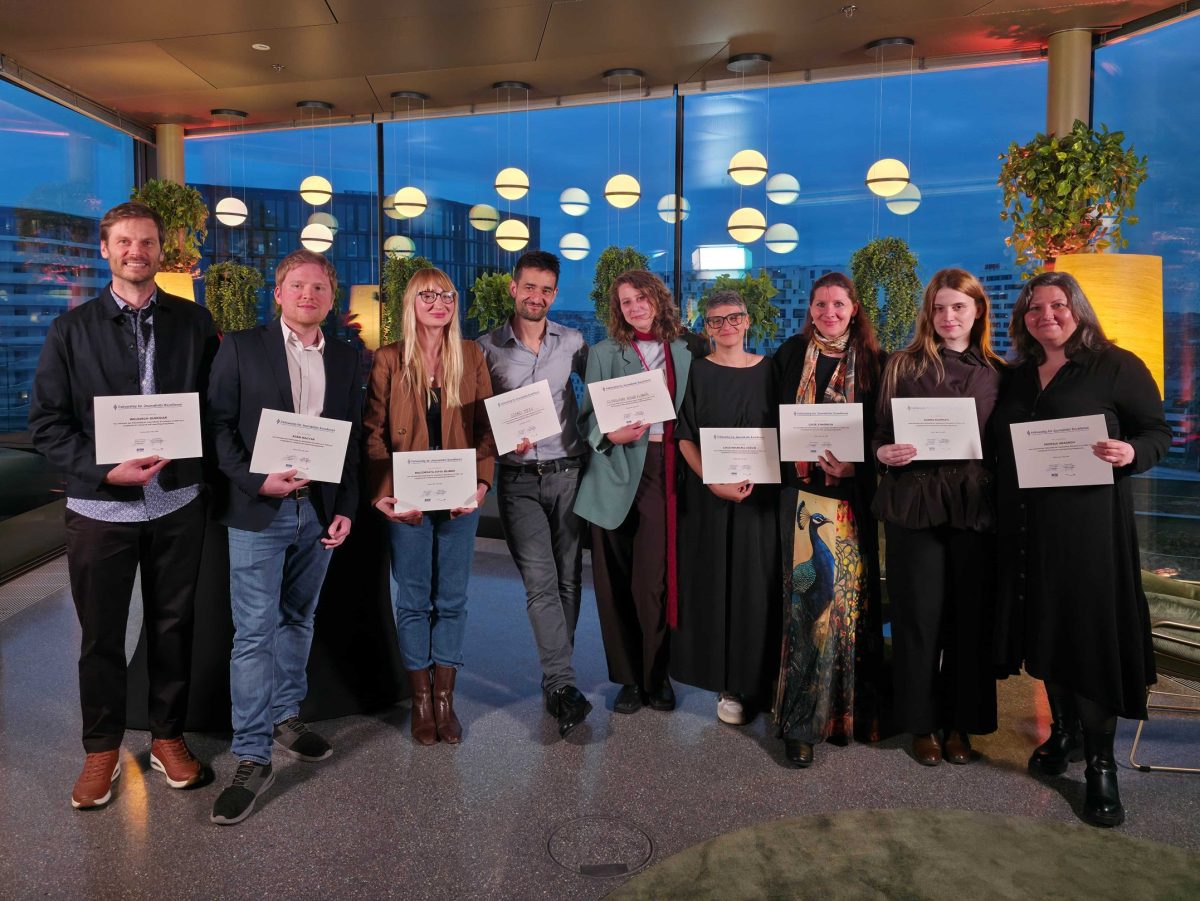
At the annual event held in Vienna on 14 May, three stories received the Fellowship for Journalistic Excellence award for their reporting on organised crime and its social impact; displacement and identity; and on structural inequalities linked to access to natural resources.
This year’s first prize was awarded to Margo Rejmer for her story examining how cocaine use became normalised in Albania and how traffickers came to be mythologised in a poor and corrupt society.
Presenting the award, Florian Hassel, Central and Eastern Europe correspondent for the German daily Süddeutsche Zeitung, said: “Margo Rejmer’s article Pizza Pasta Kokaina, about how cocaine changed Albania, uncovers a subject widely unknown to a wider European audience. It is a perfect example of investigative and explanatory reporting, undertaken with considerable personal risk, by somebody who knows the country well.” The story will be published on the Fellowship in the coming weeks.
The second prize went to Georgi Totev for his story, “Island of Castaways: Traumatic Histories Wash Ashore on Gokceada”, which explores an Aegean island through the experiences of people marked by exile, displacement, trauma and longing. Adelheid Wölfl, a correspondent for the Austrian daily Der Standard, presented the award, saying;
“Georgi Totev has written a story that weaves together the lives of migrants from different historical periods in expressive and colorful language. An island is portrayed as a place of destiny for minorities and displaced persons. The text indirectly becomes a plea for diversity and human rights and fosters an understanding of traumatic events whose effects are still felt today. Georgi Totev takes us to the Aegean Sea, he takes us to the 20th century, and with loving detail and linguistic skill, he traces the thoughts, feelings, and desires of people who were caught in the maelstrom of political decisions that shattered their identities.”
Third prize was awarded to Adina Florea for her story on water shortages in drought-stricken north-east Romania, where unequal access to running water has deepened social divisions between rich and poor, young and old, and urban and rural communities.
Presenting the award, Elena Panagiotidis, editor at the Swiss daily Neue Zürcher Zeitung, said:
“Adina has produced a piece worth reading, combining strong field reporting, an excellent use of data and clear systemic analysis. The hidden water crisis of Romania definitely is of public interest beyond Romania.”
In addition to Adelheid Wölfl, Elena Panagiotidis, and Florian Hassel, this year’s jury panel included Gyula Csák, editor at Bellingcat; Milorad Ivanović, representing the FJE alumni network; Remzi Lani, Director of the Albanian Media Institute; and Kristof Bender, deputy chairman of the European Stability Initiative.
The awards ceremony brought together journalists, editors and media professionals from across Europe to celebrate reporting that sheds light on underreported issues and gives voice to communities often overlooked in mainstream coverage.
With this year’s programme concluding, nine fellows join the FJE alumni network, which now brings together more than 150 journalists from 14 Central and Eastern European countries committed to upholding the highest standards of professional journalism.

Launched in 2007, the Fellowship for Journalistic Excellence is now in its nineteenth year. The programme supports professional development, cross-border collaboration, and in-depth reporting on key issues across Central, Eastern and South-Eastern Europe. Each year, selected fellows receive financial and editorial support to produce long-form stories on complex regional and European topics.
The Fellowship is implemented by the Balkan Investigative Reporting Network and supported by the ERSTE Foundation.